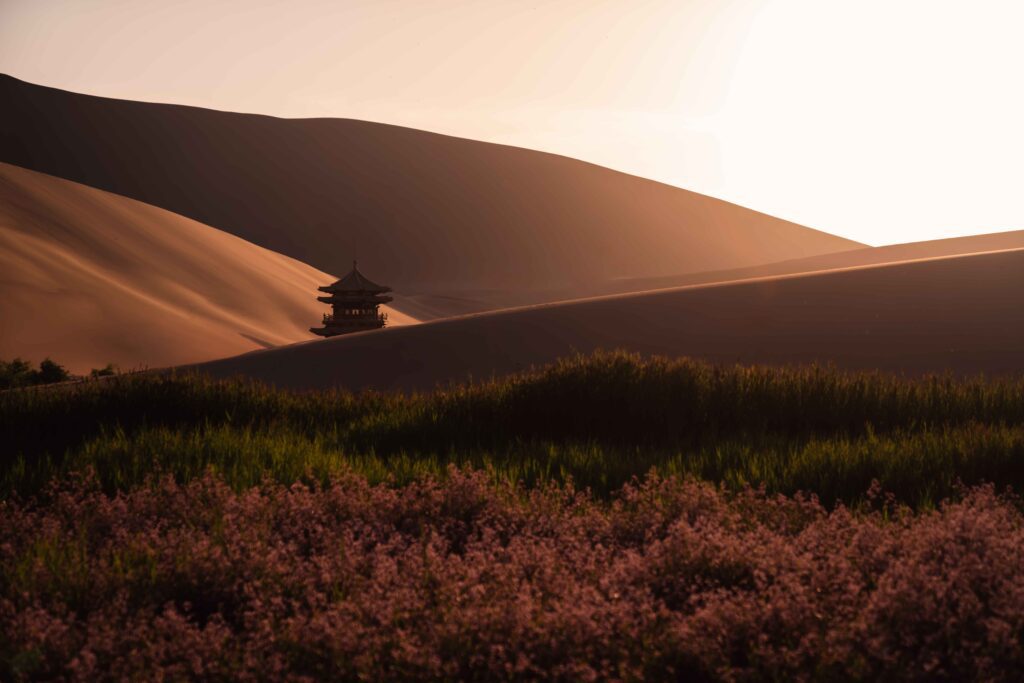
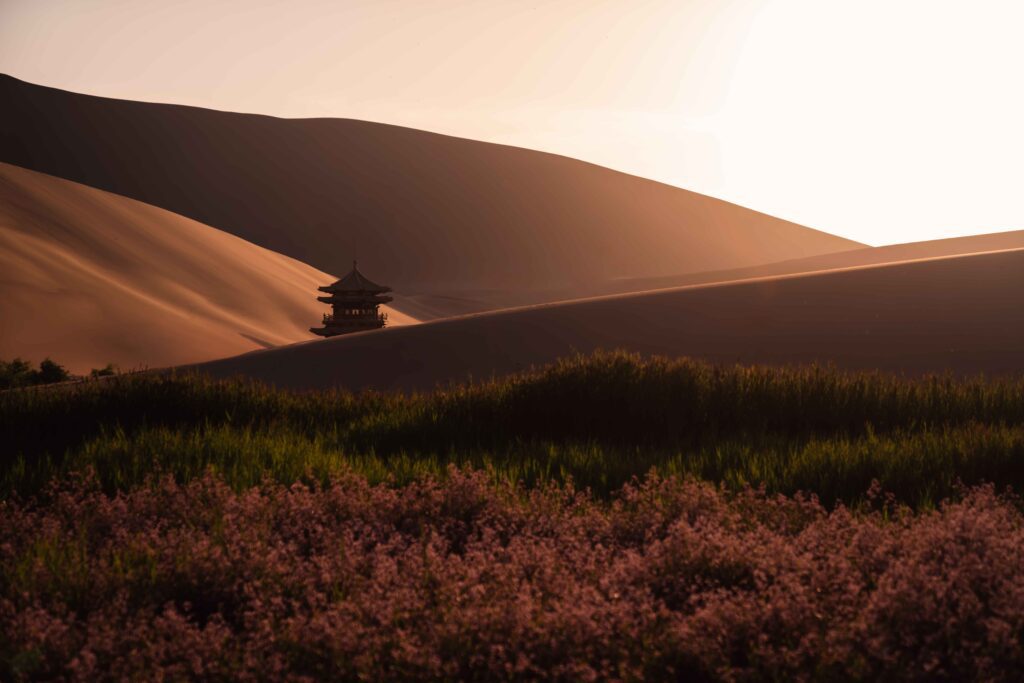
As the sun sets, we finally arrive at the dreamlike Dunhuang. A gentle breeze sweeps across the Mingsha Sand Dunes, soft grains of sand rising and settling on the slopes, veiling the city of Dunhuang in its midday glow. The city, now shrouded in a faint haze, seems like a mirage that appears across the vast desert as one journeys through it. At this moment, the sunlight is slowly fading between the peaks of the Sanwei Mountains. On the opposite cliff, countless cave entrances resemble dark eyes, silently watching over the present day of Dunhuang.
Lost in the reverie of past bustle and clamor, I look around. The pigeon-gray sky has swallowed the colors of Dunhuang, leaving only shades of gray in every direction. To the east of my view, a bright speck of light on the horizon gradually fades—it is a solar thermal power plant along the way to the Yumenguan Pass, on the Gobi Desert. By day, the 260-meter-tall tower shines brilliantly in the sunlight, gleaming like a star. For the people of Dunhuang, it is the source of their energy; for travelers from the West, it stands as a lighthouse in the vast ocean of night, beckoning with exaggerated and fervent brightness, saying, “Dunhuang is just ahead.”
But at this moment, everything is quiet and vast—only the desert, the Gobi, and the howling wind. Dunhuang before me has been reduced to a series of simple geographical symbols. However, if we consider the paved road linking Dunhuang to the Yumenguan Pass as a videotape, we would be amazed to discover that this nearly barren land once recorded so many dreams, passions, desires, and celebrations. Ordinary people from both East and West set foot on the ancient Silk Road, and on the land of Dunhuang, with their idealism, they built a glorious era.
The winds and sands that once blew across Dunhuang have now buried the footsteps of merchants and travelers, but the splendor of the Silk Road is not confined to the surface, nor limited to the imagination of the present. The brilliance that once emanated from the life of Dunhuang has transformed into the heavenly vistas captured by the artist’s brush. Just as the ancient Silk Road, covered beneath the sand, hides its radiance, seeking this brilliance requires stepping into the dark and the desolate. It remains silent in the stone caves of Dunhuang, where the wind and sand swirl, and time stands still.
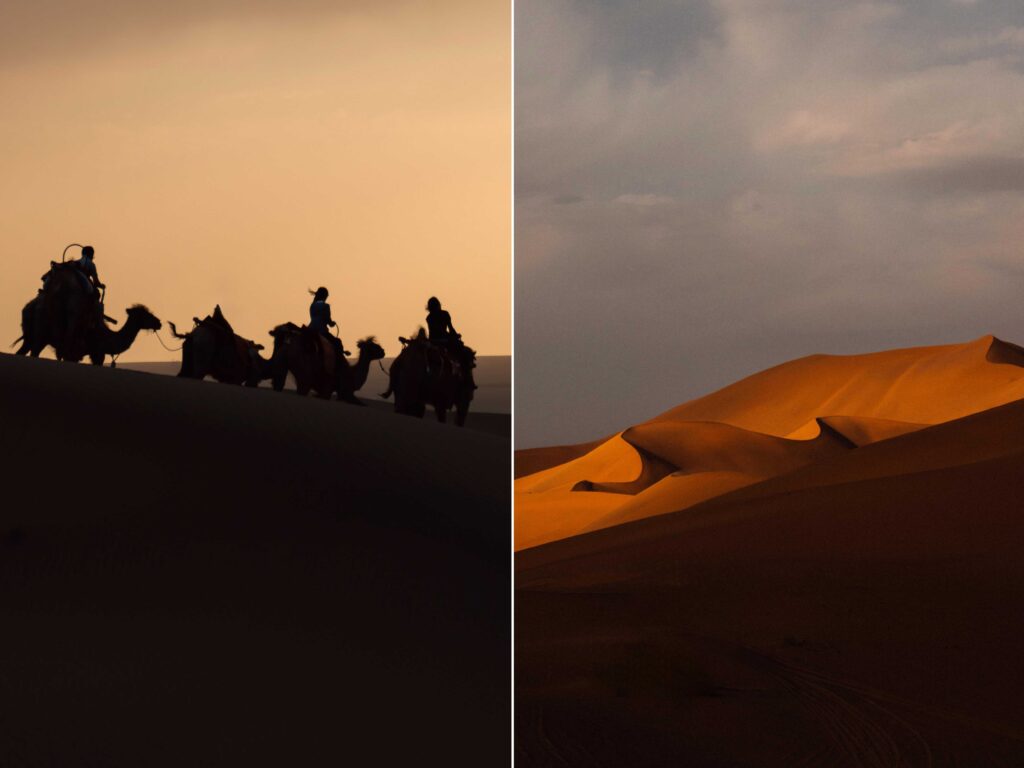
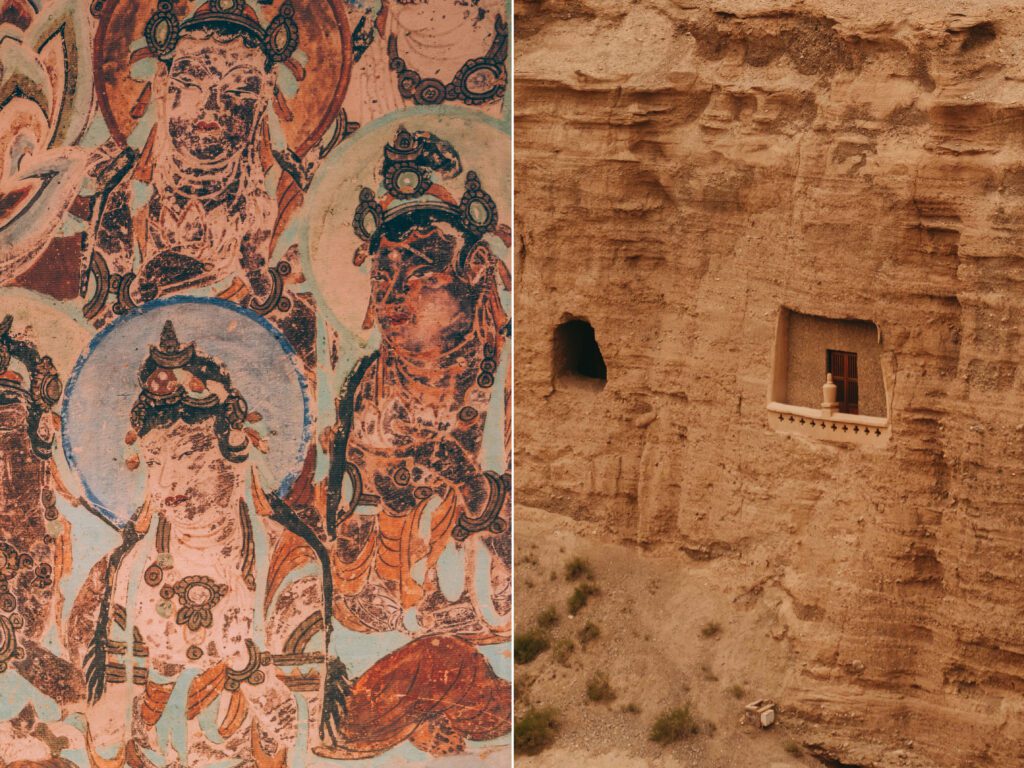
The Mogao Caves, the closest to Dunhuang city, are my first destination in the exploration of these grottoes. As we gradually approaches, we drive along the expansive riverbed between the Sanwei and Mingsha Mountains. On the eastern bank, the sand dunes stretch endlessly, while the cliffs on the western side rise sharply like jagged knives. The Mogao Caves stand perched upon these cliffs, with hundreds of caves embedded between the rock faces. From a distance, it appears as a giant beehive, brewing the sweet nectar of ancient human civilization’s convergence. Despite being on the outskirts of the city, the journey to the caves alone is enough to make me feel the immense power of human curiosity and devotion in the midst of the vast desert, where such great civilizations have emerged.
The researcher, Xiao Hu, is my guide for this visit to the Mogao Caves. In his early thirties, tall and slender, with a delicate and refined face, Xiao Hu specializes in Buddhist studies. Having pursued his PhD in Hong Kong, he unhesitatingly moved to the sandstorm-ravaged northwest, immersing himself in the pitch-black caves of Dunhuang. Each day, he carries a small flashlight, wandering through the dazzlingly complex world of Buddhism, illuminated by the flicker of his light.
Though young, Xiao Hu exhibits remarkable familiarity with the caves, carefully curating the route for our visit. Each cave he chooses is a true gem. The murals and statues, sealed behind the cave doors, lie dormant in the darkness, waiting like actors backstage before their grand entrance. As we open the doors, light pours into the cave, and the faint hues in the darkness gradually unfold with each step we take, like the opening scene of an exotic and magnificent drama.
Following Xiao Hu’s guidance, I climb a winding wooden ladder along the cliffside, reaching the middle level of the southern section of the caves, where many from the early Tang Dynasty were carved. “You’ll absolutely love this one,” Xiao Hu has mentioned repeatedly as we approach. He gently pushes open a wooden door, and a beam of bright sunlight immediately illuminates the colors and shapes in the dark.
The faint glow of the flashlight and the sunlight blend together, casting light on the north wall of the cave, as though a film projector were casting its beam. Squinting in the darkness, I observe the murals: lotus flowers bloom, their petals floating atop rippling waters. Beside the Buddha and Guanyin, palaces rise, with water pavilions and corridors, and gods surrounded by flowers and auspicious clouds. The floor is covered with pearls, agates, gold, silver, and glass jewels, with rare and exotic beasts weaving through, chasing the flowers scattered by the gods. In front of a lotus pond, on a jade pillar stage, musicians are singing and dancing, their instruments full of foreign charm. To the soaring and powerful music, two dancers leap into the air, swirling their silk scarves, as a spectacular scene unfolds before my eyes.
The cave in front of me is the most open and spacious of all the ones I have visited, without any obstructing pillars or Buddha altars. The light of the real world shines into the cave, greeting both the sunlight and the visitors. This, I think, is the essence of the Sui and Tang dynasties. The central pillars I had seen earlier in the Northern Wei caves are gradually fading away, making way for the central Buddha altars of the Sui and Tang periods. With the change in light and brightness, the once-divine Buddhist art now appears more approachable and grounded in life. I believe this shift undoubtedly helped the spread of Buddhism.
The moment Xiao Hu opens the door, the entire cave embraces us with its expansive openness, and before my eyes, it unfolds in all its grandeur. In the face of visitors and cultures from across the Eurasian continent, the ancestors of the Tang Dynasty welcomed them with confidence, broadening their horizons and creating an open space for the fusion and collision of diverse cultures, which gave rise to art that was unique, proud, and full of varying charm.
I look at the north and south walls and notice that the Buddha niches have been moved to the center, leaving the walls on either side intact. All the statues are positioned facing the entrance, as though reflecting the ancient imagination of the Buddha’s dwelling place.
As I step into the cave, several Buddha statues seem to emerge before me, their overwhelming presence filling the space. They are solemn and compassionate, gazing intently at the passage of time. The central Buddha sits serenely with a gentle smile, like a guiding light, illuminating the wishes and wisdom of all beings; the Bodhisattvas on either side are dignified and majestic yet radiate kindness, their silken robes flowing smoothly, clinging to their forms with fullness and vitality.
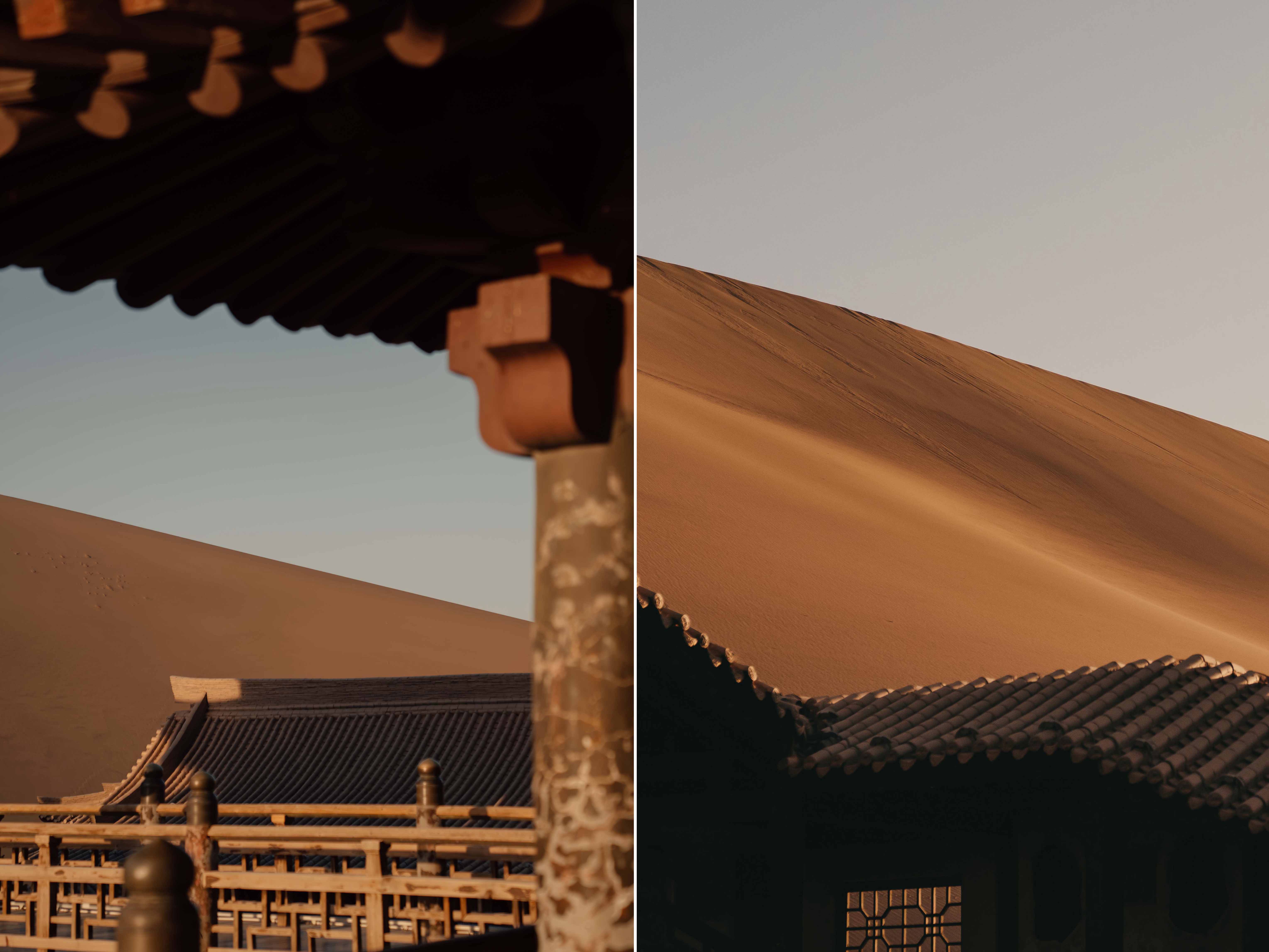
Xiao Hu guides me to look at the painting of the Eastern Medicine Buddha Sutra on the northern wall. The faces of Central Asian figures, their dance poses, and musical instruments, the pavilions and terraces in the background, the grapes and pomegranates in porcelain bowls… Flowers bloom through the seasons, and jewels scatter across the ground. The fluid and natural brushstrokes of the mural reflect not just the imagined paradise, but the everyday sights and sounds of the people during the Sui and Tang Dynasties.
Before the Sui Dynasty unified China, the flames of war during the era of the Five Barbarians and Sixteen Kingdoms had left the people wounded. The Han people, enduring the turmoil, sought refuge in Dunhuang, this remote sanctuary. Thus began the migration of Han civilization and the spread of agricultural techniques. Along with the Han people, the descendants of the Yuezhi, who had never disappeared from Dunhuang, also made their mark. The Sogdian people, who evolved from the Yuezhi, were renowned as the most enterprising traders along the Silk Road. They controlled the lifeblood of Silk Road trade, dealing in silk, jewelry, livestock, and slaves. Beyond wealth, they also brought the “Hu winds” of fashion to the Tang capital of Chang’an. This influence transformed into the painting style of “Cao Yi emerges from the water,” the pipa technique of “ruo feng yu” (like wind and rain), and the rotating, effortless dance of the “Hu Xuan Wu”—a dance that never leaves the mat…
In the painting, the dancer, wearing a jeweled helmet and flowing, wide-legged, leaf-ruffled pants, stands on a round carpet, bending one leg and twisting her body as she sways her arms in dance. As her swift twirls whip the air, her hairpins and scarves float in midair, her braids scattering like clouds. It’s a scene that vividly echoes the words of Yuan Zhen, describing the Hu Xuan dance: “The pearls burst from the earring, chasing the flying stars, and the rainbow-hued scarf whips like flowing lightning.”
During the peak of the Silk Road, as people encountered the diversity of customs and cultures in their daily lives, both emotions and aesthetics underwent a tremendous transformation. Life itself became a realm of flourishing, with the only fear being death and the afterlife. The artists, in turn, infused the most joyful and beautiful elements of daily life into their depictions of heaven.
Buddhist art in Dunhuang during this period nearly transcended its religious divinity, becoming filled with the warmth of human emotion. This is the expression and record of reality after the intense collision of the world’s four ancient civilizations—an expression of ordinary people’s love for life and a record of the heights of civilization that could be created through East-West friendship.
Even after a millennium, when I stand before these murals and figures, I can still almost hear the friendly conversations of the people, see their pursuit of elegance and beauty in every gesture, and feel the love for life that ordinary people had during the most prosperous era of East-West exchange, as well as their attention to and exploration of their inner selves. Individualism, always, is the most vibrant hallmark of an open and prosperous society.
Coincidentally, after Dunhuang, when Dutch merchant ships brought enormous wealth to the Netherlands, Dutch artists’ pursuit of individualism led to the pinnacle of Dutch painting.
Always remain curious and excited about both foreign cultures and the inner self—that is the key that unlocked the prosperous era of Dunhuang and the towns along the Silk Road.
Born from the exchange between East and West, Dunhuang Buddhist art continued to blend and grow as the Silk Road expanded. From the pursuit of liberation from suffering to the search for joy, from religious mysticism to the happiness of daily life, from reverence for the Buddha to introspection of the self, from darkness to clarity… The trade of goods along the Silk Road evolved into an even more important cultural exchange and collision of spiritual emotions, creating the brilliant art treasures of Dunhuang that continue to shine through the ages.
The moment I step out of the cave, Xiao Hu and I stand silently face to face—a moment of quiet reflection after experiencing immense spiritual fulfillment.After bidding farewell to the Yulin Grottoes, I drove back towards Dunhuang. As I neared the Guazhou border, a bright flash of white suddenly appeared where the vast Gobi Desert meets the horizon. It shone dazzlingly under the scorching sun, reminiscent of the solar thermal tower I had seen outside the city of Dunhuang. As I drew closer, the white speck in my vision grew larger. At first, it was just a tiny glimmer in the heat haze; then it transformed into a massive white rectangle; finally, the rectangle expanded into an overhanging roof and tower, becoming a monumental sculpture shaped like a white city gate.
I stopped my car and walked closer for a better look. Beneath the towering sculpture was a modest plaque, inscribed with the words “Wujie” (Boundless). This timeless and ethereal name left much to the imagination, resonating harmoniously with the expansive and desolate landscape around it.
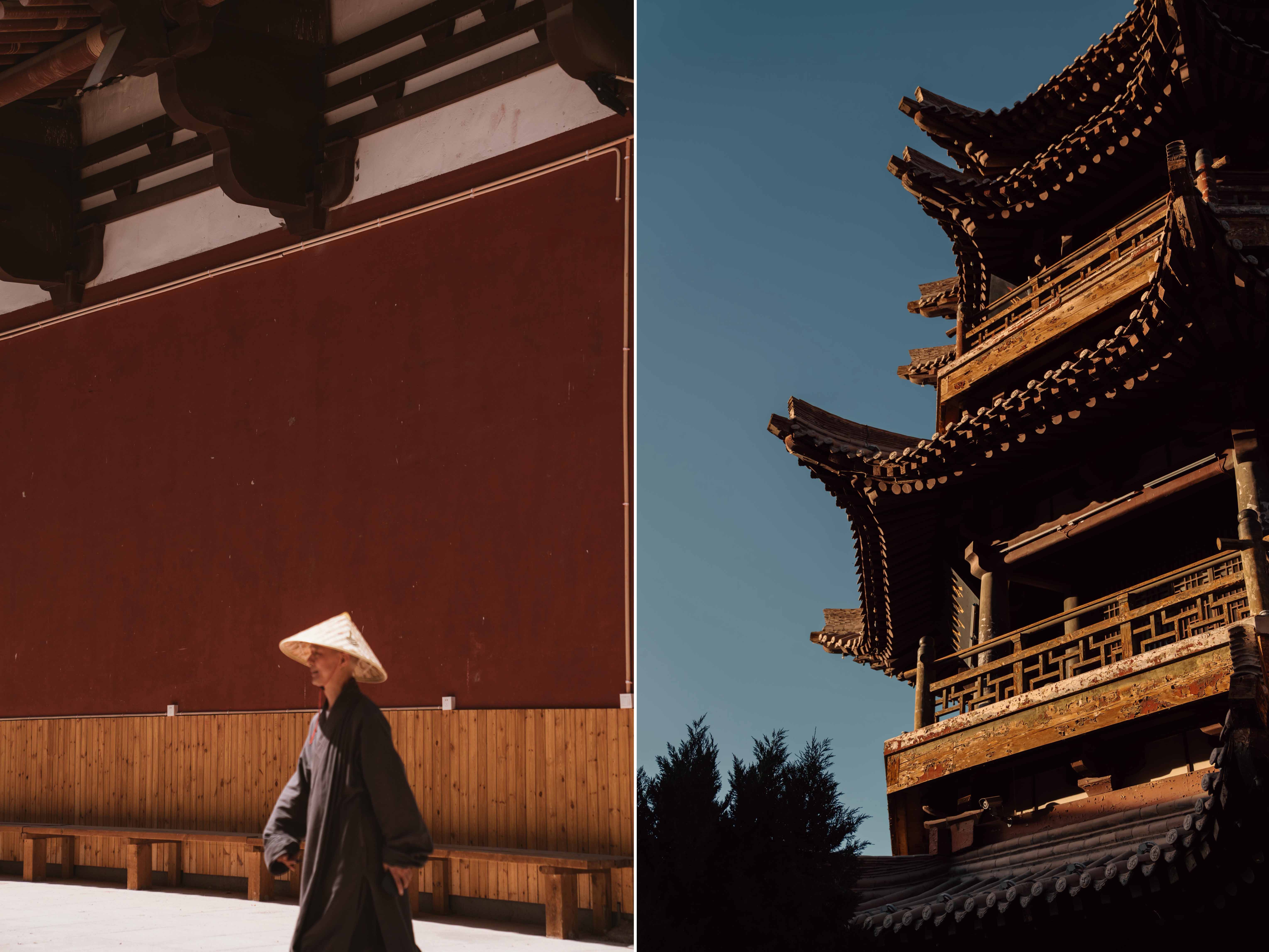
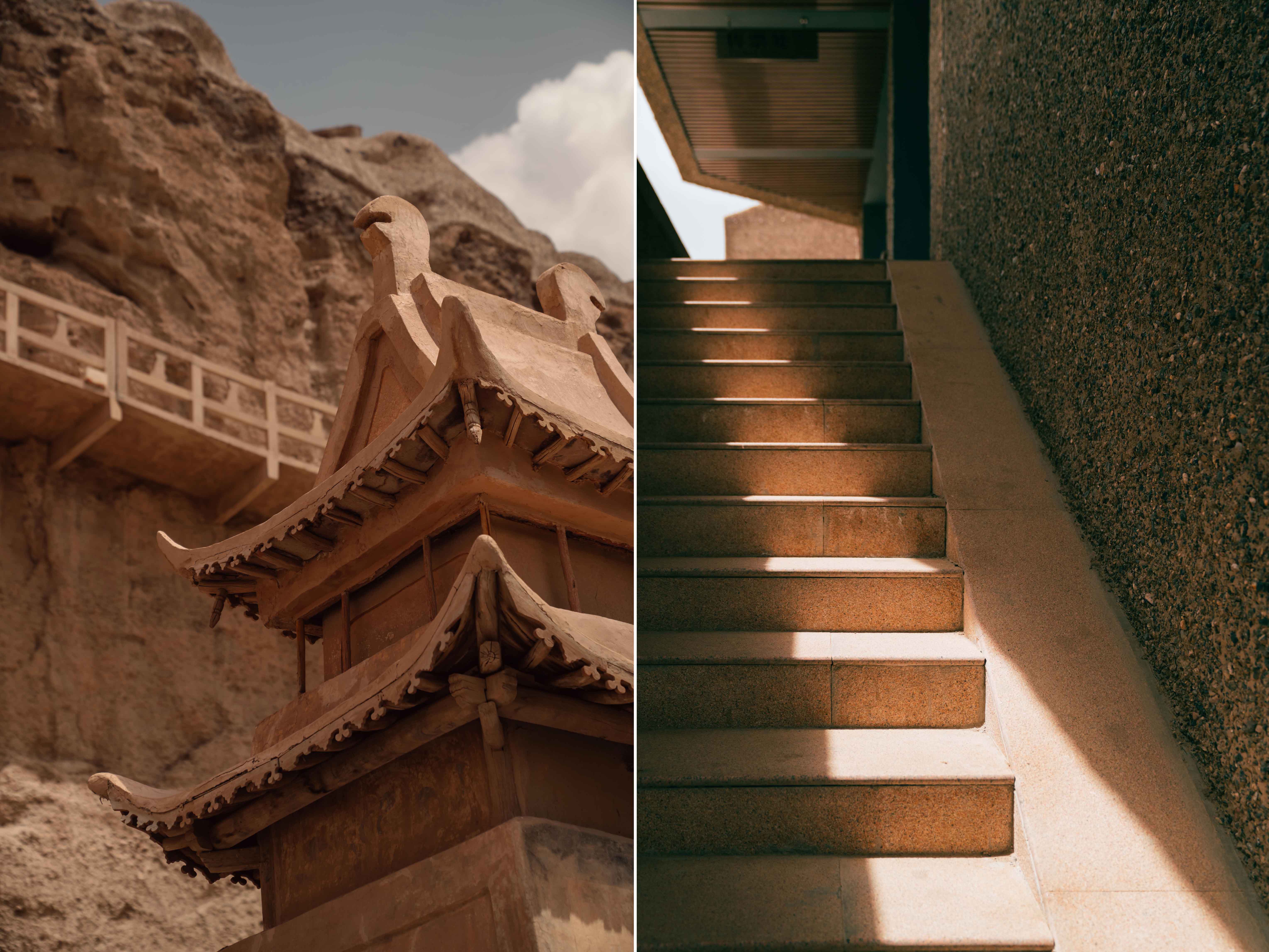
The sculpture rose on the barren Gobi Desert, with a main hall, four towers, and several city walls, all crafted from white steel pipes. The city gate, standing along the ancient Silk Road outside Dunhuang, represents the concepts of “arrival” and “departure.” It could be the Yumenguan Pass, the Yangguan Pass, or any gate linking the East and West. While the wind and sand had consumed the walls and relay stations that once stood here, this white city gate sculpture rose out of the wilderness, grand and imposing, almost as if it were deliberately showcasing the bustling prosperity of the ancient Silk Road in Dunhuang.
Unlike most land art installations, “Wujie” was created and constructed on-site by the artist in the desert, as described on the plaque. It is as though the ancient people, using wood and mud bricks, had once built city walls in this desolate place. The gleaming steel pipes, combined with the parched desert and deep blue sky, create a striking, pure simplicity that mirrors the visual presentation we are most familiar with today while walking the desert Silk Road. The inspiration for “Wujie” came not only from real city gates but also from the pagoda-like structures commonly found in Dunhuang’s Buddhist murals. In the Tang and Sui dynasties’ caves, the heavenly realms were often depicted with grand pagodas and pavilions. The Western Pure Land was formless, and the artists’ aesthetic experiences and materials were drawn from their everyday life. For the ancients, the royal palaces represented their ideal models of beauty.
Dunhuang art, at its core, is an idealized form.
Standing beneath the vast sculpture, I could almost feel the awe of the Western merchants as they trekked through the scorching desert, seeing towns appear like mirages on the horizon. The excitement of finally glimpsing Dunhuang shimmering in the oasis must have been overwhelming. Dunhuang, that distant East, carried with it wealth and new beginnings. For these Western travelers, Dunhuang was no longer just a name in the distance; it was right at the end of this road, in that shimmering place.
A light breeze stirred the sand, and in that moment, I seemed to hear the faint sound of music.
Who, in this vast desert, could be playing?
I glanced around and suddenly noticed, across the asphalt road, nearly a hundred steel pipes stood like a dense forest in the gravel. They swayed in the wind, clashing against each other, producing different sounds at various points: deep wails, passionate high notes, and resonant hums. They rose and fell, intertwining, like a symphony in motion. I bent down to search and, once again, found the name “Feng Yuzhe” (Wind Speaker) on another plaque, almost lying flat on the ground.
Guazhou is known for its frequent strong winds, and an old saying goes, “Every year, a wind blows from spring to winter.” The “Wind Speaker” sculpture commemorates the earliest visitors along the Silk Road. The formless wind, ever-changing and drifting, moves through the dust of the world, gently yet powerfully shaping this land. The wild winds that blow day and night outside Dunhuang have carved the “White Dragon Piles,” a unique landscape known as the Yadan landform. The undulating white mounds, like a white dragon swimming through the sea of sand, devour the optimism and dreams of the Western merchants traveling through Dunhuang. But these winds also gently sweep over the poplar groves of Danghe and Yulin, transforming into the clouds and auspicious symbols depicted in the Dunhuang murals—clouds that swirl in the mountains and rivers of this world, like the heavenly kingdom in the sky.
The wind was both the muse for the artists who once lived in Dunhuang and the ominous presence that struck fear into the hearts of the merchant caravans.
Under the blazing sun, the steel pipes clanged together, and the music gradually grew more intense. The sand and dust lifted into the air, stinging my face. I shielded my face with my hands, but no matter which way I turned, the wind surrounded me from all sides, as if I were in a concert hall, where the notes surged from every corner, overwhelming my senses. The sound of the “Wind Speaker” had lost its earlier gentleness, now replaced by wildness and harshness. If this was the sound familiar to the Western merchants during their long journey, what kind of willpower and passion for the East would be required to face this fierce and uncontrollable force head-on?
In that moment, I thought of the Sea Organ in Zadar, by the Adriatic Sea. The people of Zadar gaze toward the setting sun each day, feeling the sea breeze in their ears. On the coast, they constructed massive reinforced concrete steps and installed copper reeds inside. As the sea breeze flows, the reeds moan and sing. The wind never stops, and the music continues endlessly—a symphony entirely played by the sea. Zadar is near Venice, both cities standing at the western end of the ancient Silk Road. If Dunhuang is seen as the starting point for departure from the East toward the West, the artists from both Dunhuang and Zadar, living in vastly different cultural environments, nearly simultaneously transformed the same endless natural wind into a song that could be heard. The desert, like the ocean, might be blowing the same wind. This is no coincidence; it is the artistic gene and romantic imagination left by Silk Road culture over the centuries.
The people of Dunhuang, living in the vast desert, and the people of Zadar, attuned to the sea, never met in person, yet they both sang in harmony at the two ends of humanity’s great exploration. Standing in the forest of steel pipes, immersed in the delicate and passionate melody, I was deeply moved.
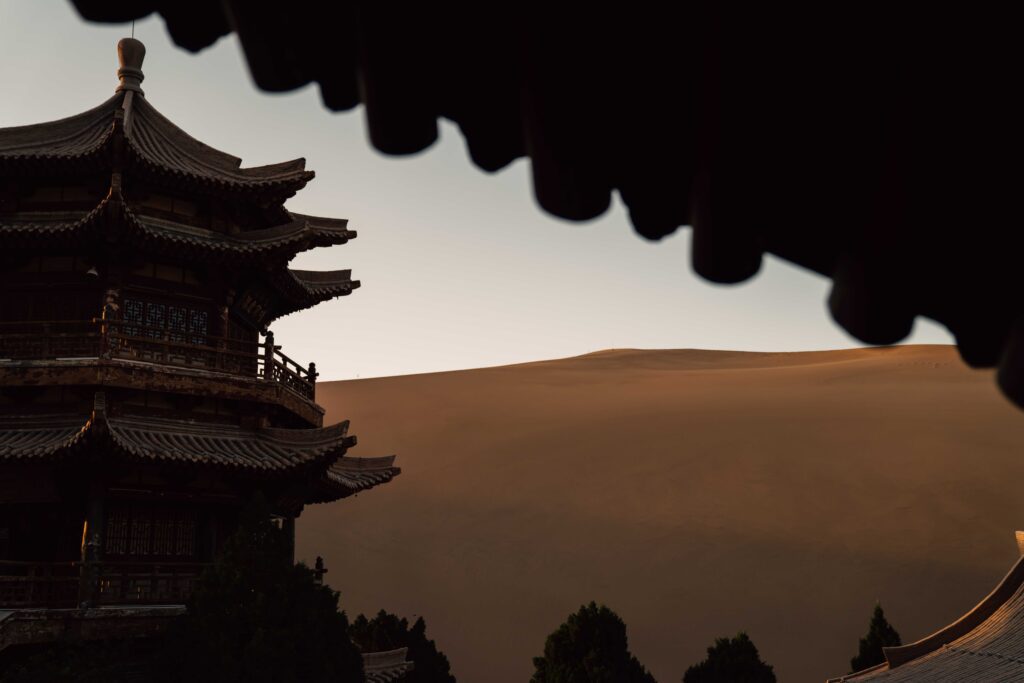
“Wind Speaker” and “Wujie” stand side by side, offering a superb auditory and visual experience for travelers on this desolate land. This scene is nothing less than a re-enactment of the heavenly life depicted in the Dunhuang murals. Beside the grand pavilions and pagodas, musicians from the Western regions beat drums and pluck strings, while the steel pipes dance, resembling the elegant movements of dancers. Looking up at the sky, the clouds swiftly moving in the wind are like auspicious clouds accompanying the gods. In the sunlight, I can almost see the flying goddesses’ silken scarves fluttering, along with the petals they scatter.
The lives of a thousand years ago were transformed by artists into idealized heavenly realms, and today, that ideal has revived in Dunhuang, becoming a scene we can see and hear in the earthly realm.
The Silk Road of Dunhuang continues to stretch across the vast desert. Beyond the high ridges and across the plains lies a vast blue ocean. There, the ancient and arduous road of stones and sand will transform into a smooth new blue channel, and among the ceaseless waves of the sea, the ripples of civilization will faintly emerge.