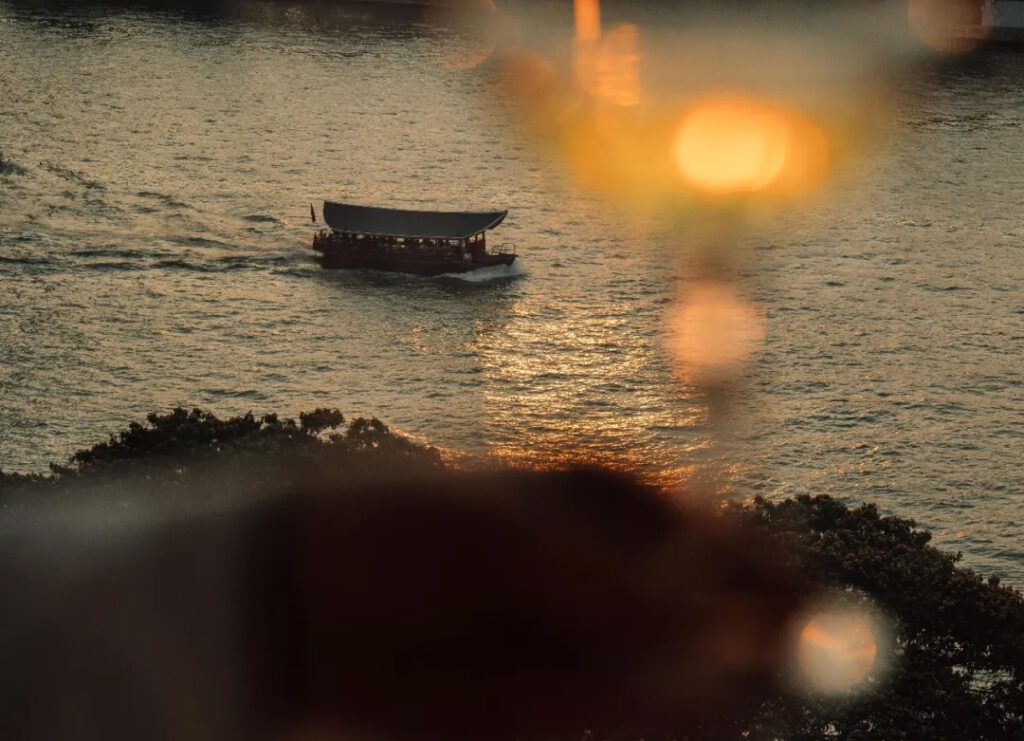
The ferry takes ten minutes. From the east bank of the Chao Phraya to the pier of Capella Bangkok on the west, ten minutes is all it requires. At three in the afternoon, the river runs a scorched brown beneath the tropical sun, its color shaped by silt, heat, and the long passage through the city.Beyond the dense dark green of the western shore, glass curtain walls catch and scatter the light, carrying the barely believable vitality of modern Bangkok from deep within the city all the way to the waterfront, where it finally dissolves into the river’s glittering surface. The noise of the city is swallowed by the sound of the ferry and the slap of water, leaving only the low murmur of fellow passengers and birdsong from somewhere above. A summer that never ends, in every season of the year.
Many years ago I read a Bangkok city guide published in the 1920s. Describing the Chao Phraya, it wrote: “She carries everything, and forgets nothing.” This river, which bears nearly half of Bangkok’s sense of reverence, holds almost all the memory that modern Bangkok has chosen to keep. More precisely, the portion that people wish to remember. And the stories people wish to remember have almost all taken place on the east bank. The west bank of the Chao Phraya has thus become the blind spot of modern Bangkok’s travel writing.
The literature about this city has never truly crossed the river.
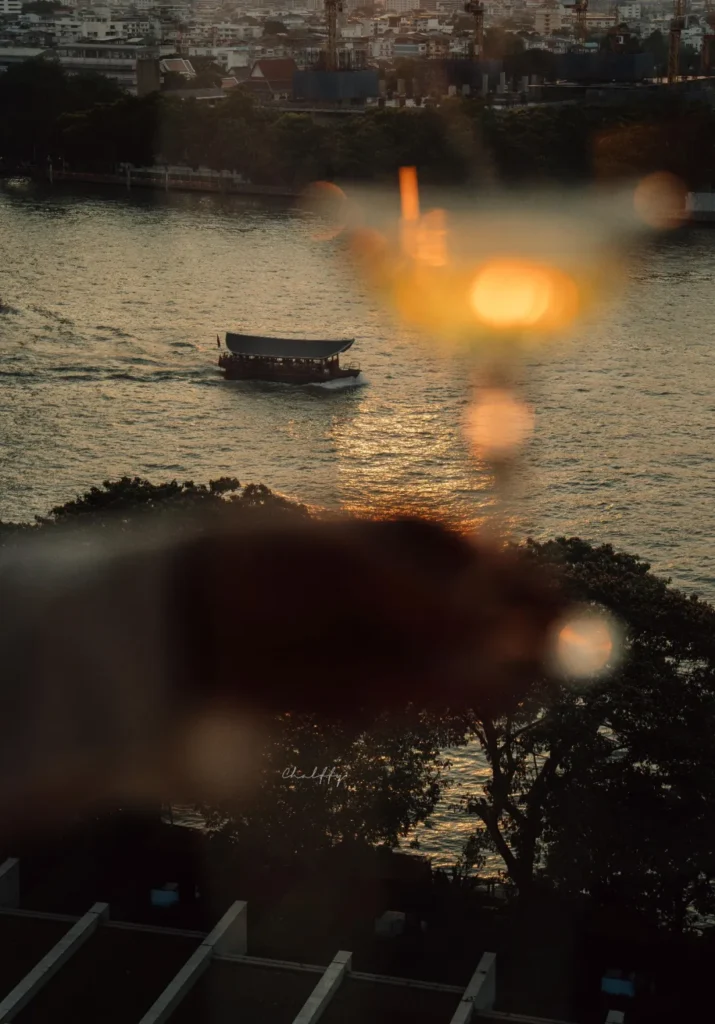
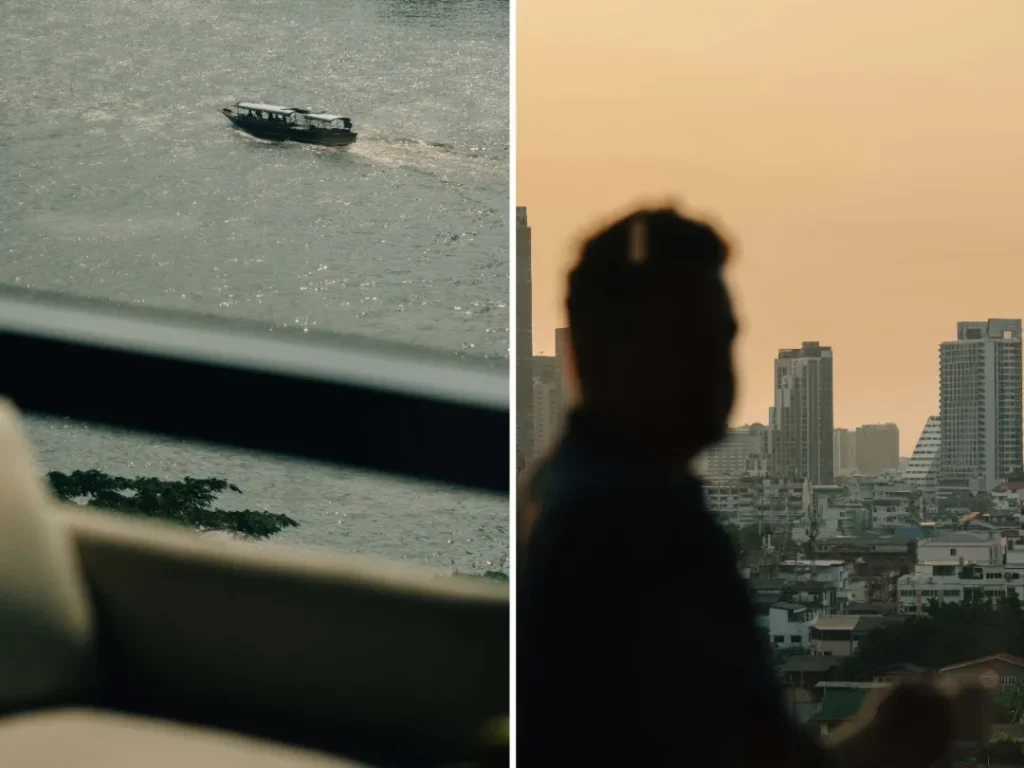
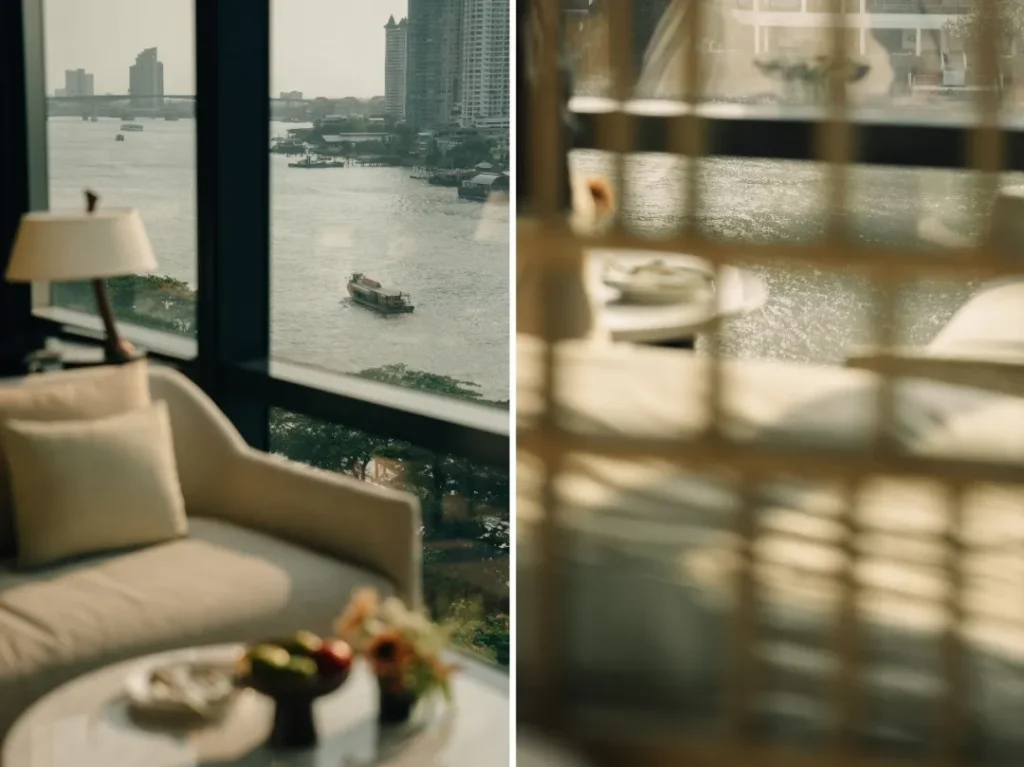
On this visit to Bangkok, I stayed at Capella. It was only as I was leaving, watching the light move on the water, that I understood I had been standing on this forgotten shore all along. The room’s terrace faced the river; across the water was the Bangkok that countless words have described, while on this side, the quiet had the quality of history’s other face. Each morning before dawn, the vessels on the Chao Phraya began their restlessness. After sunrise, canoes, barges, and motorboats moved to and fro, tracing countless paths across the surface, and I imagined them setting out on many accidental and unhurried journeys.
It is curious: I have always felt an inexplicable nostalgia for Bangkok. Inexplicable, because I have come here only a handful of times. Yet the feeling is strangely vivid, as though I have long known this place. Like something from a dream, Bangkok presents a fusion of the material and the spiritual that I find entirely familiar, then reassembles it in some new, almost symbolic form. The Chao Phraya especially, and the towers spreading outward from its banks, their design, the marks of time upon them, their arrangement, all remind me of the international city posters I saw as a child. That was the world of the late 1990s, when the past was still hazy and the future seemed to hold a genuine promise.
The Architecture of Happiness
Turning off the busy, somewhat weary Charoen Krung Road into the grounds of Capella Bangkok, my first impression was of an immense emptiness. Not merely visual, for the entrance here is astonishing in its spaciousness, but an emptiness of sound as well. The engine noise and motorbikes of Charoen Krung Road ceased abruptly, leaving only wind and birdsong.
Entering from the main road, one passes first through courtyards and latticed screens, the river deliberately kept from the first glance. The design seems to embody an ancient narrative wisdom: the things that truly move us understand the art of delayed arrival. Only upon stepping into the lobby did that concealment give way to expanses of floor-to-ceiling glass, the river unfolding before me with dramatic completeness, at once ceremonial and unhurried. Surprise requires preparation, and the entire entrance becomes a gathering of anticipation.
Walking through the hotel, I was continually aware of a sense of shelter given by the high corridors. The proportions of the space seemed to answer a quiet question: from where should the scale of architecture begin? Grandeur and shelter are, in architectural terms, entirely opposing ambitions. Grandeur draws the eye upward, and looking up so often makes one feel small. Shelter can only truly be felt from within.
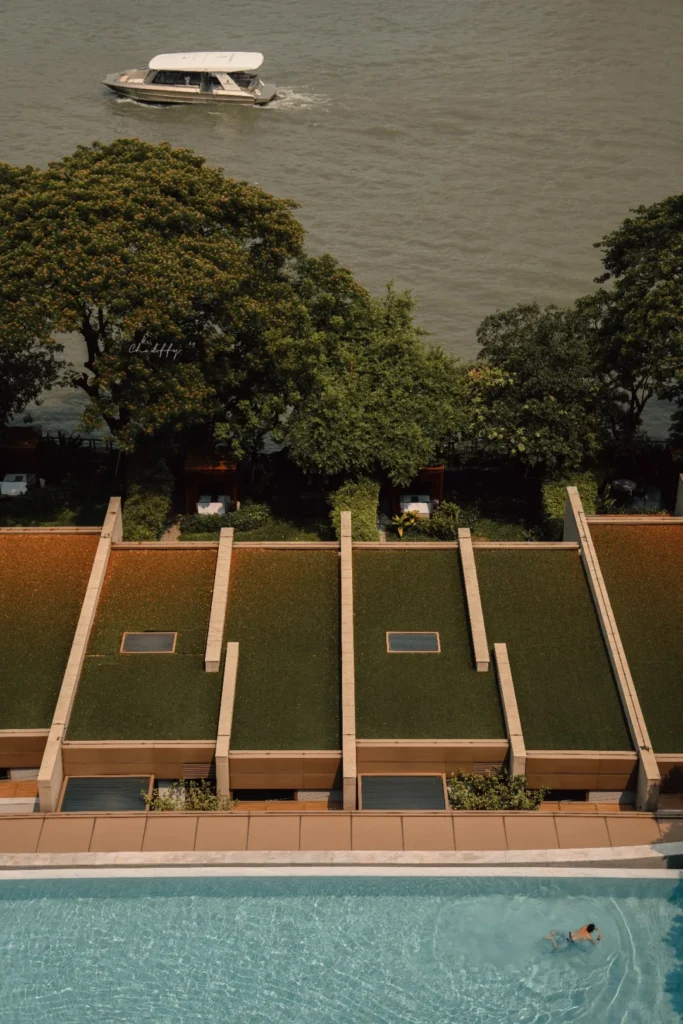
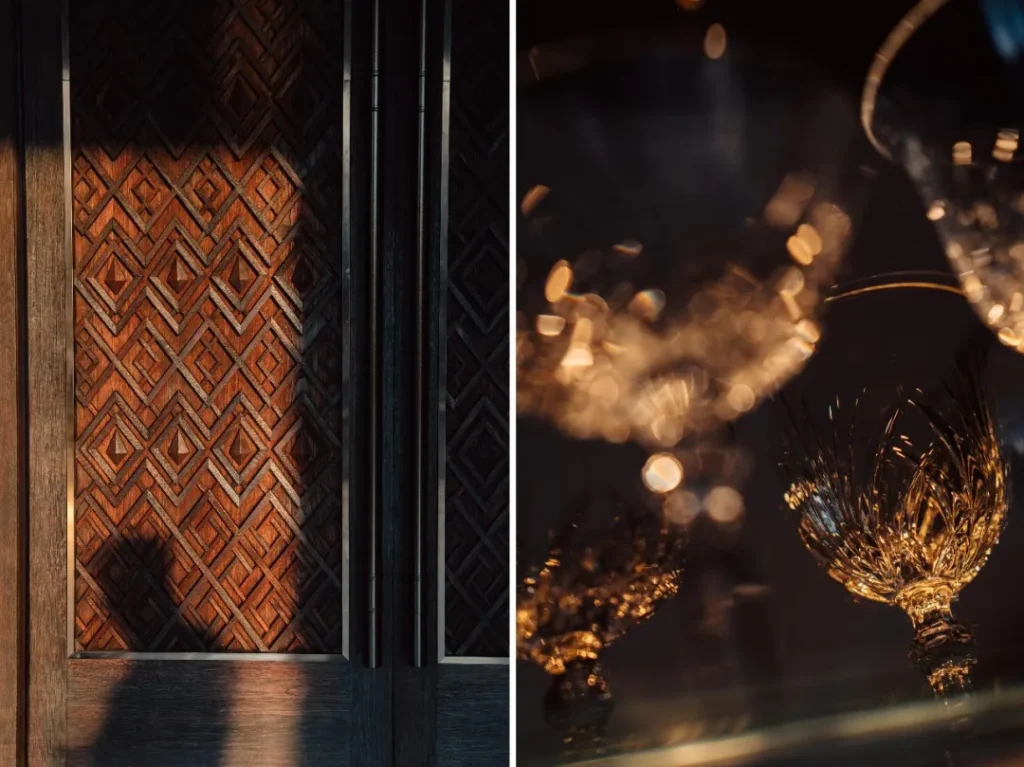
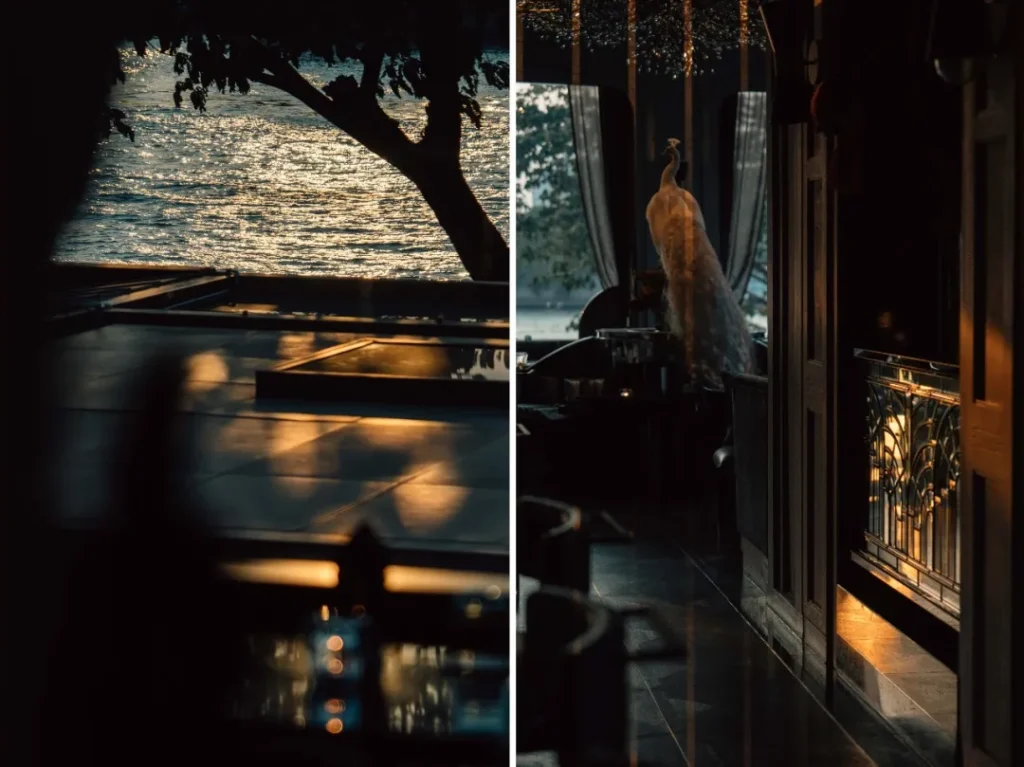
The design of Capella Bangkok clearly follows the body’s perception rather than any purely visual pursuit of the spectacular. The building makes no effort to rise dramatically. Even set among the low urban fabric of Charoen Krung Road, it remains quietly concealed behind a canopy of dense foliage. This reticence creates a powerful tension against Bangkok’s characteristically extroverted spirit. The main building extends horizontally along the riverbank so that even on the lower floors, guests command an open view of the river, and the scale remains in conversation with the surrounding colonial-era buildings. Interiors of teak, ivory, and bronze, with louvered shutters and projecting eaves, draw on the shading and ventilation wisdom of traditional Thai architecture. Light and shadow make their own enclosures. The river and the daylight become the true protagonists.
All of this accords deeply with what Thais call sanuk. Sanuk means ease and pleasure, an engagement with life that is worth having. The idea permeates Thai everyday philosophy: anything without sanuk loses its reason for being done. Traditional Thai architecture shares this instinct. It does not aspire, as Western classical architecture does, to sublimity or monumentality as its first purpose. Whether in the open ground floor of a house on stilts, the temple corridor where monks and worshippers rest without ceremony, or the awnings that grow naturally from the edges of floating market piers, there is always an unguarded warmth. Space should be light and temperate, and should put people at ease before it inspires awe.


Charoen Krung Road: The First Scar of Modern Bangkok
Capella Bangkok faces the Chao Phraya and turns its back on Charoen Krung Road, the first road in the modern sense that Bangkok ever had. Walking its southern section, one moves along the edge of the old Chinese quarter. On both sides, medicine shops, bird’s nest dealers, amulet stalls, and gold merchants press together, arcaded shophouses against Buddhist temples, one after another without interval. From the late nineteenth century into the early twentieth, large numbers of Teochew people came by sea from Swatow and landed at the mouth of the Chao Phraya. They worked as laborers, in the rice trade, in mining, and eventually in commerce. They brought their own deities, language, calendar, and food, and over successive generations wove themselves into Thai society, entrusting their longing for home to clan associations and temples. Bangkok’s talent today for trade, for food, for adaptation, was shaped in no small part by these people.
The birth of Charoen Krung Road had its own logic. In 1861, Rama IV ordered it built, because European merchants in the city were persistently complaining: Bangkok had nowhere to walk or ride, one traveled entirely by waterway, and this was no way for a modern city to present itself. So the king gave them a road. Charoen Krung Road was, from the beginning, built to be seen, a modern face the city consciously fashioned for itself. Throughout my stay I often stood in the corridor looking down at this road baked dark brown by the sun, and found myself wondering: was Charoen Krung Road born because Bangkok yearned for modernity, or because it refused to be defined by others as a place still awaiting it?
Thailand was never colonized by the West, and this is a matter of genuine pride. Yet to remain uncolonized is not to remain untouched. Influence finds more complicated channels: active importation, selective absorption. Rama IV and Rama V understood this well. They hired European advisors, sent princes to study in England, built Western-style palaces, corresponded in English, and simultaneously preserved the monarchy, Buddhism, and the core structures of Siamese society. Charoen Krung Road is the most vivid material expression of this selective modernity.
Westerners came, took rooms in the hotels along the road, and wrote this place into their books, fixing the world’s first image of Bangkok, of the Orient. But what they wrote was their own story, not the story of the road. That story lies elsewhere: in the medicine shops, in the immigrants who left no names behind, in the shrine at the back of an arcade that has received incense for decades.
In “Sam Peng Lane,” we can still see what this quarter looked like before Charoen Krung Road was fully laid: “When the road was not yet completely filled, there were still many small canals on both sides. The back doors of the arcaded shophouses had boats tied to them. Before dawn people would row out to the markets on the Chao Phraya, and return with fish and shrimp, vegetables, flowers, and fruit. With each pull of the oar, the reflection of Wat Arun shattered on the water.”
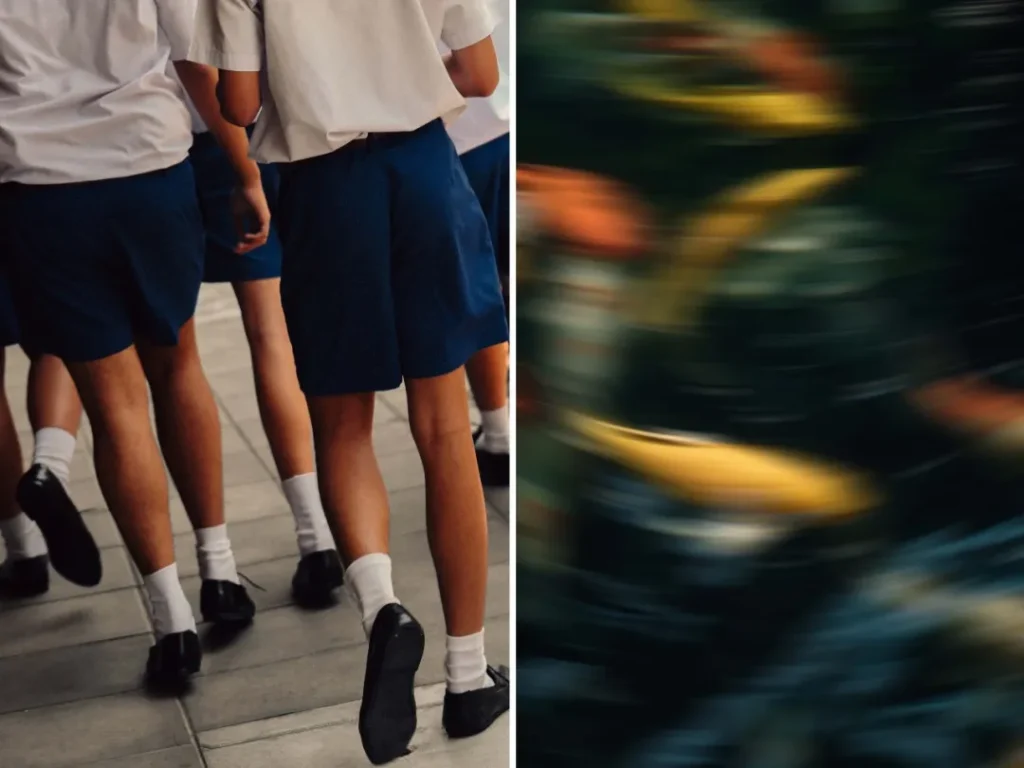
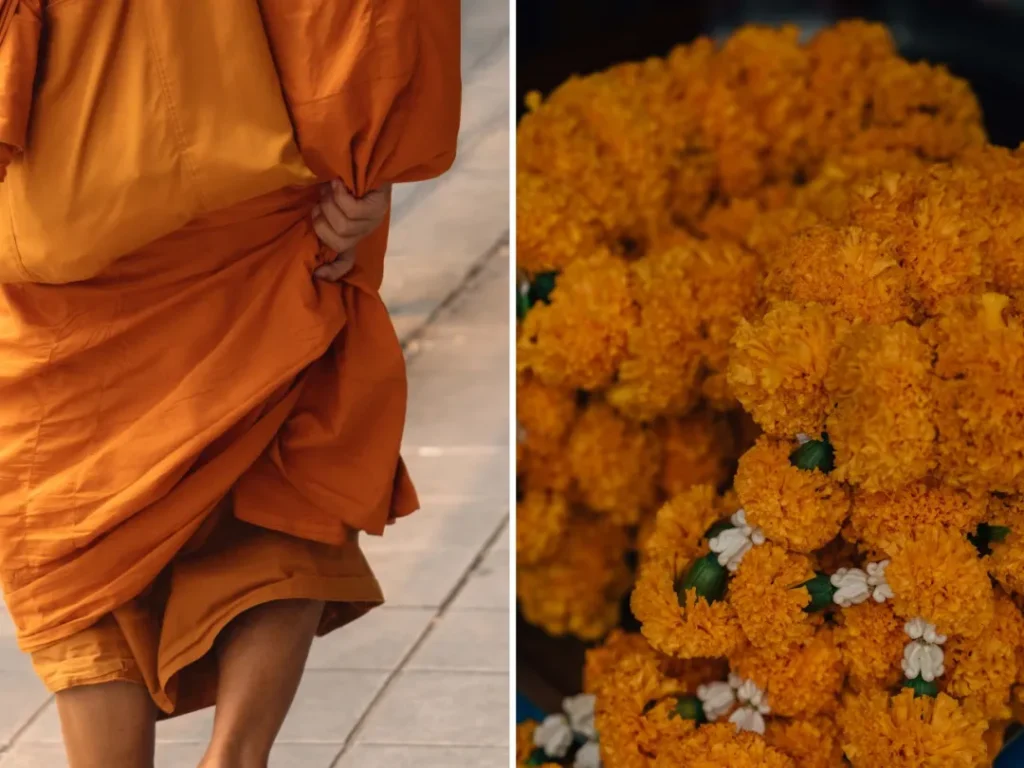
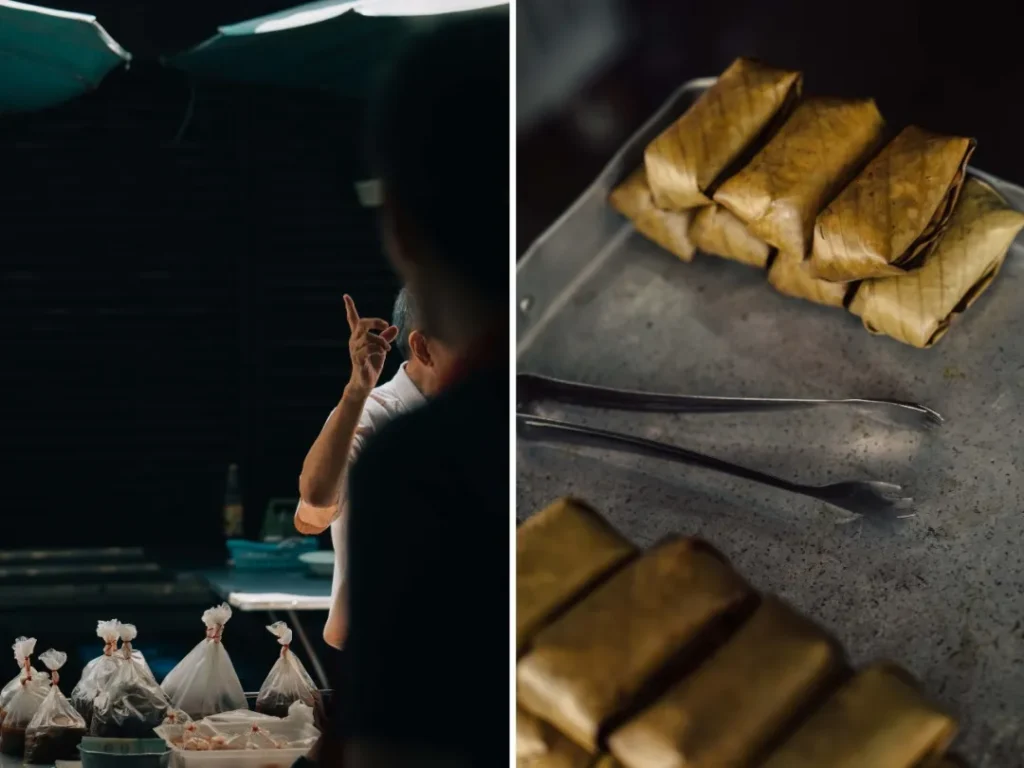
In a sense, it is the first scar of modern Bangkok. Pamuk writes of Istanbul and its deep melancholy, the shadow left by the Ottoman Empire, the color of the Bosphorus in winter. Bangkok carries no such melancholy, or at least the tropical light and vitality have dissolved a portion of it. But Charoen Krung Road has its own sadness, a very quiet sadness that makes no announcement of itself.
Many writers who have described Bangkok have written of its humidity, its desire, its decay and charm. What Charoen Krung Road brings to my mind is the word continuity. Everything here seems to be changing, yet the manner of change always bears the marks of what came before. Like those city magazines I remember from the 1990s, Bangkok still exists suspended between its past and its future, holding both at once, letting them slowly interpenetrate and reshape each other, beautiful beyond reason, chaotic beyond remedy.
It has accommodated so many contradictory ways of life, so many layered pasts, and still the city moves forward. Such a road is worthy of its own name: the City of Angels, the city that flourishes.
The Chao Phraya: The City’s Collective Memory
Bangkok was born on the water. To seek the city’s past, one should not look to its streets but to its rivers. Palaces, temples, piers, and markets unfolded one after another along the Chao Phraya, casting their reflections in turn upon both banks. Even today the traces of this ancient order remain.
Every morning I sat at the riverside restaurant at Capella for breakfast, and before me was usually this: barges and cargo vessels passing one after another across the water. At that hour the river was gray-blue, like a piece of metal not yet polished, still and reserved. The engines emitted a low rumble, and the wakes broke the surface behind them. In the distance a small boat was selling noodles; a few crows circled above. Only after the morning mist began to lift would the Chao Phraya’s true day begin. As the morning advanced, Bangkok ceded the entire river to its visitors, until the sun went down in the west. The Chao Phraya receives everything cast into it: flower petals, oil slicks, lamplight, prayers, rainwater, forgetting.
In “Tristes Tropiques,” Lévi-Strauss writes of traveling by boat deep into the Brazilian interior, saying that every journey outward is a retreat through time. The Chao Phraya requires no such upstream effort. One need only stand at its bank, and that sense of moving backward rises from the soles of one’s feet. The warships of Ayutthaya once assembled here. What did the river witness in the year the Burmese came? King Taksin established the Thonburi Kingdom on this bank; Rama I moved the capital across to the other side. A kingdom’s rise and fall, its migrations, were accomplished again and again by way of this river.
This is why I have always felt that the light on the Chao Phraya carries a kind of weariness. Not the weariness of decline, but the composure of something that has seen too much.
And so the Chao Phraya is not only the past. She is equally Bangkok’s present and future. Every day, countless people’s livelihoods and daily rhythms depend upon this river. Boats carry cargo, ferries carry visitors, markets open in the morning light, and temple bells still carry across the water. The things that truly endure tend to change very slowly: the rhythm of the tides, the direction of the monsoon, the human longing for belonging, the tastes at a family table, a lantern set upon the water on a festival night.
Human society always weaves its order between nature and culture. Bangkok lays this structure openly before one’s eyes: Charoen Krung Road is the ambition of culture; the Chao Phraya embodies the patience of nature. The former demands submission to rules; the latter teaches one to accept exceptions. Bangkok’s life is the balance struck between these two forces.
The position of Capella Bangkok is itself a quiet homage to the city. Behind it, Charoen Krung Road belongs to the era that believed in the future. Before it, the Chao Phraya is a city’s origin and its collective memory. The fastest life still needs something eternal by which to measure itself. The newest era still needs something ancient in which to rest.
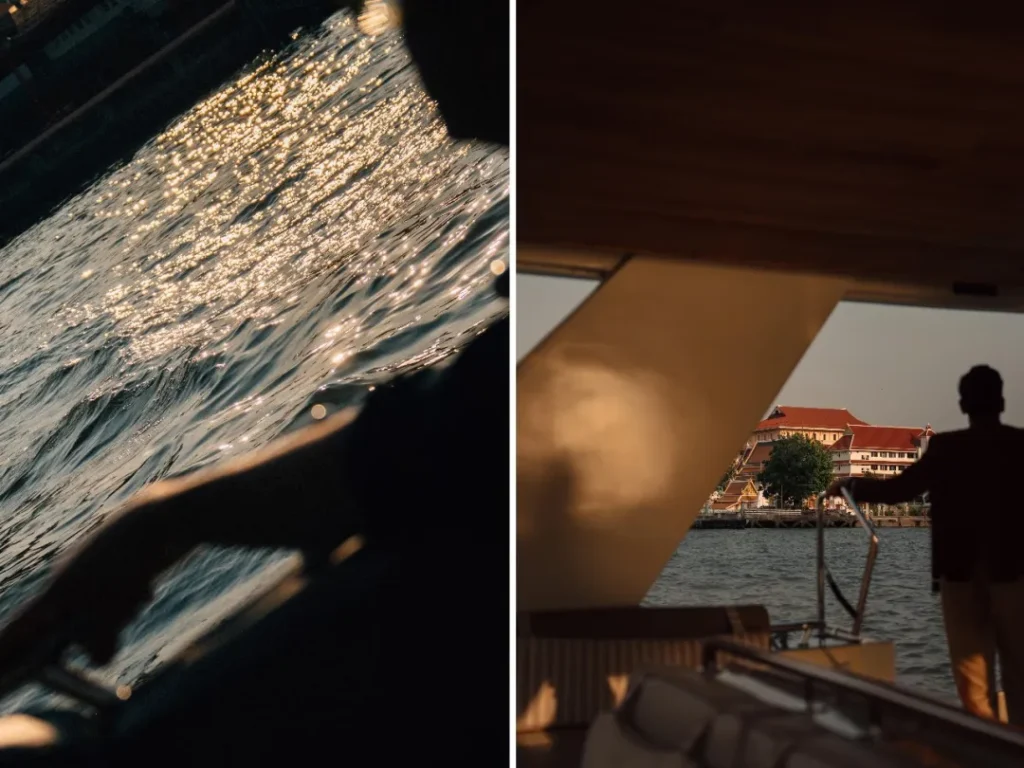
On the night before I left Bangkok, I took Capella’s private ferry south along the Chao Phraya back to the hotel. Looking carefully to my left, I could see spread along the bank an almost continuous timeline of Bangkok’s opening to the world. Following the line of Charoen Krung Road, the grand hotels of successive eras stood beside the river, each adjacent to the last, from the glamour of earlier days to the sensibility of the present, all the way south to Capella, spanning nearly an entire century.
It was the world’s understanding, in each of its eras, of what Eastern elegance might mean. Like one long drawing room that had once been full of passing ladies and gentlemen who talked, lingered, and then quietly departed. The eras have changed, but the lights have never gone out.
The Chao Phraya flowed slowly in the moonlight, the surface alive with small broken silver. On the evening wind came the smell of fish, of coming rain, and of sandalwood, the most unforgettable scent of old Bangkok. At this hour, Bangkok had put aside the noise of the day and returned to what it had always been: a city truly built upon water, quietly carrying everything forward.