The journey to Tangier began in chaos that never quite came under control.
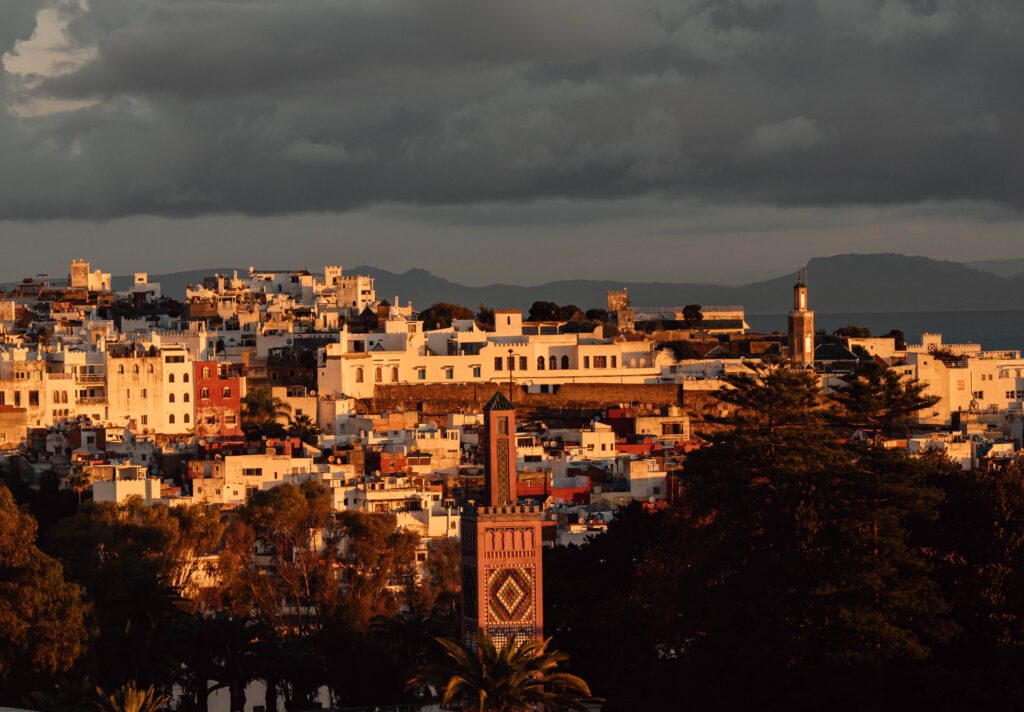
A winter storm struck at the very moment of my arrival, a vast grey sodden cloth flung down with brute force, obliterating the entire coastline at a single stroke. The following morning’s newspapers reported it with great solemnity as a once-in-a-century Mediterranean phenomenon, and the people of Tangier have always needed that kind of grand pronouncement, as though a rainstorm can only be properly borne if it is first elevated to something epic. En route from the station to the medina, the white buildings I had imagined cascading down the hillside like piano keys were swallowed entirely by mist.
The disorder had announced itself even earlier, on the train. When we pulled out of Casablanca, the carriage had been commandeered by supporters bound for the Africa Cup, two hours of unbroken songs and drumbeats, a happiness so elemental it carried a faint edge of aggression. I thought of Tangier’s peculiar years after the Second World War, when the city floated at the margin of world order under international administration, belonging to no one. If the city itself was a geopolitical accident, then the noise filling that carriage seemed, by some inverted logic, more fitting than any silence could have been.
The taxi laboured up a slick, steep incline. I remembered that Mr. Tahir had written somewhere of his grandfather, a man who had lived in Tangier for half a century, dying in a road accident on one of these very slopes leading into the city. The streets narrowed. Walls on either side broke my field of vision into jagged fragments, as though the city were testing the patience of anyone who dared enter. And then, without warning, the Grand Socco burst into view.
It was a circular square. Date palms thrashed in the downpour, their outlines dissolving into something watercolour and unresolved, giving the whole scene a quality of deliberate obscurity. The teahouses and cafés around the perimeter were jammed with people sheltering under narrow awnings. Our taxi moved slowly around the roundabout, and I felt something peculiar, as though the whole city were holding its breath and examining me.
I had come expecting the Tangier of bright sun and vivid colour. Instead, through that veil of cold rain, the city revealed something truer: it has always been a place at the edge of things, ancient, self-absorbed, and carrying the deep, knowing fatigue of a place that has seen entirely too much.
A Border City Without Borders
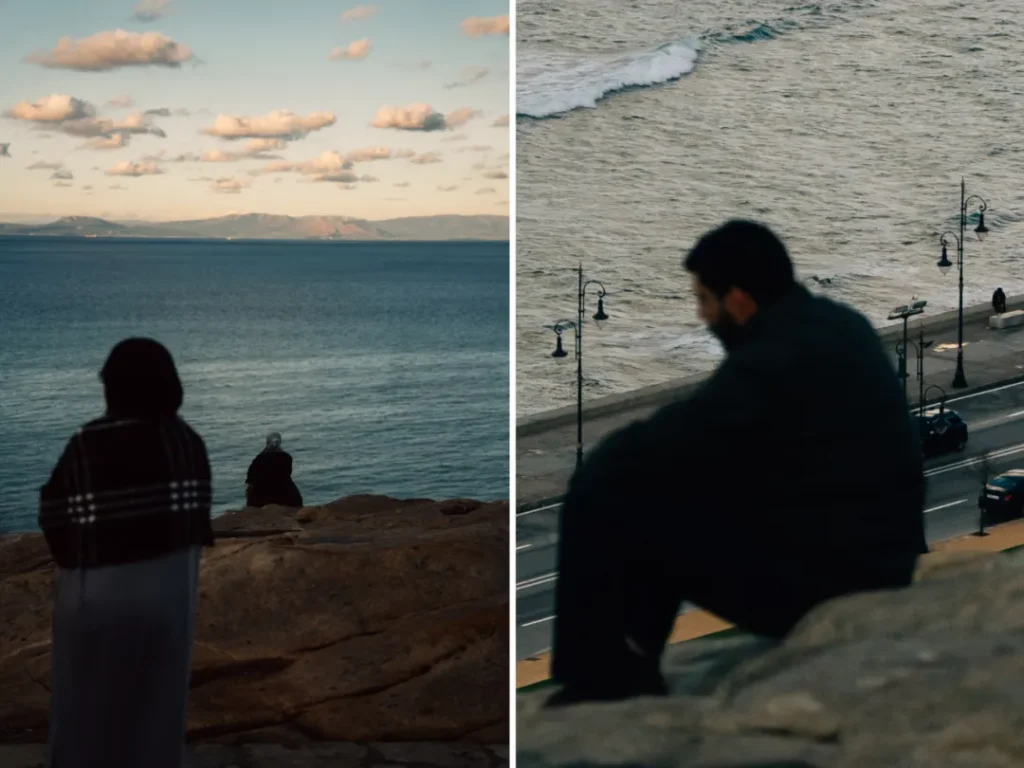
Before sunrise, the sky over Tangier turns a blue so pale it is nearly transparent. I stood on the hotel terrace breathing air that tasted of coarse salt and mint. Below, in the harbour, several ferries were cutting across the silken surface of the Strait of Gibraltar, bound for Tarifa, Spain’s southernmost tip, only a short crossing away. The sun climbed slowly through the seam between two continents; Europe dissolved into a golden haze.
From this side of the water, Tarifa looks close enough to be a promontory that Tangier itself has thrust out into the sea. Pressed and pulled between two landmasses, it sits in a kind of solitary detachment, belonging to neither. The Strait at its narrowest is fourteen kilometres across, yet in that early light the water seemed wider than any ocean. This was no illusion of physical distance but something more essential, a fundamental fracture. South of the water, time appears to slow; the light falls at a sharper, more penetrating angle; even the wind carries the low exhalation of another civilisation.
Lévi-Strauss wrote that every true journey is a small death and a small rebirth: you must first lose your existing frame of reference before you can begin to sense a new world. Tangier is perhaps one of the most accomplished cities on earth at performing this operation. The moment a visitor arrives, the city begins quietly withdrawing the foundations of his identity, a gentle motion, and an irreversible one.
History gave Tangier a label that reads almost like a conjuration in the annals of Western literature: the International Zone. From 1923 to 1956, administered jointly by Britain, France, Spain, and Italy, the city became a genuine terra nullius on the map of the world, with no single sovereign, no unified currency, no coherent legal logic. It was a smooth stone held simultaneously in several powerful hands and perpetually slipping between their fingers. In that absurd interlude, Tangier opened itself to tax fugitives, spies, exiles, avant-garde artists, and all manner of moral frontier-dwellers, receiving everyone with a near-dissolute generosity and then, with equal composure, absorbing them entirely.
William Burroughs wrote Naked Lunch here. Paul Bowles came and stayed for half a century, until he died. Then came Kerouac, Matisse, Capote, the Rolling Stones, each of them believing they could grasp Tangier and press it into their own narrative. But the words and works they left behind look less like their own creations than like the marks the city scratched into them. In a late interview, Bowles said that what made Tangier irresistible was precisely its refusal to offer a stable, observable self. I turned this over in my mind on the train coming up, and saw in it the outline of a deeper geographical philosophy: some places exist in order to remain unresolved.
Tangier is not a city we have not yet understood. It is a city whose very mode of existence is to remain beyond understanding.
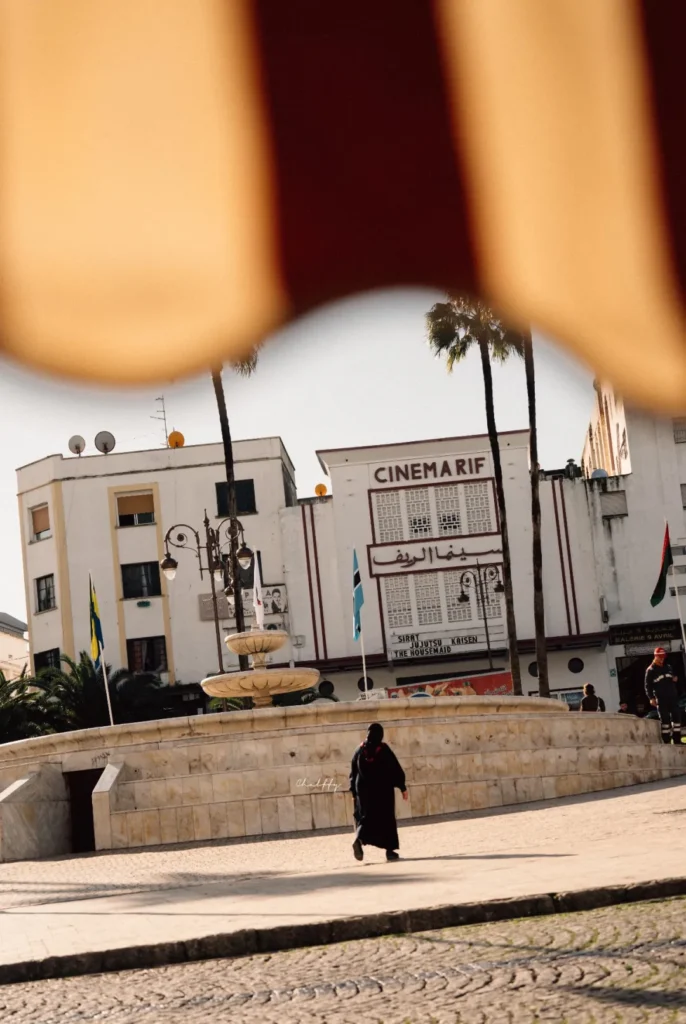
Jan Morris, writing of Venice, once observed that certain cities are mysterious not because they conceal something, but because they are made of contradictions. Tangier is exactly this. It is the point of departure for thousands of people who attempt each day to cross into Europe, and the terminal destination for European travellers descending in search of the exotic; it is Morocco’s most modern shop window and the custodian of North Africa’s oldest market rhythms; it once sheltered the world’s most celebrated exiles, and has itself always existed in a kind of wilful self-exile.
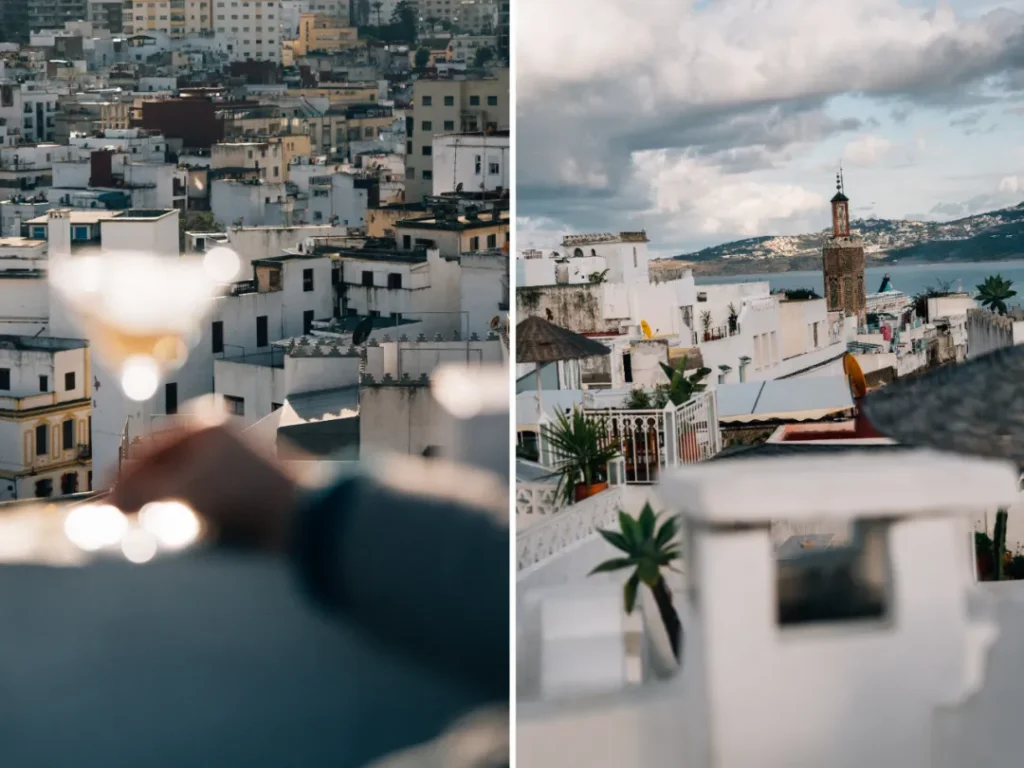
Each afternoon I fell into the habit of walking the medina’s lanes, which twist like viscera. In the noon sun, the whitewashed walls gave off a light that was almost cruel, and the cobalt-blue wooden doors seemed like openings into another dimension entirely. The alleys of Tangier’s old city are, in their way, purer than Istanbul’s. They carry none of the heavy doctrinal weight of an imperial capital, and instead have the easy, unguarded looseness of a port town.
Here, the border has a peculiar physical presence. Tangier stands at the northernmost tip of the African continent, commanding the passage between three continents, on the threshold where the Mediterranean meets the Atlantic, and was once among the most legally labyrinthine border zones in the world. Yet it is precisely because so many boundaries converge here, layered, colliding, cancelling each other out, that the result is a strange condition of boundlessness.
Walking those lanes so narrow they nearly crush the eye, I found myself wondering: who invented the border in the first place? In an anthropological sense, borders are the fortifications civilisations erect in order to confirm themselves. We define the other in order to steady our own inner order. The history of Tangier is, in one reading, an archive of borders repeatedly drawn, erased, and repainted. Each redrawing admits one group and expels another; makes one language the decoration of power and forces another into the privacy of the home. And yet the city itself, with its extraordinary inertia and elasticity, has absorbed all these cuts and converted them, every last one, into the constituent elements of its own mixed nature.
Half an hour’s drive from the city centre, along a road that rises and falls with the hills, past woodlands and a royal residence, lies the old lighthouse at Cape Spartel. Standing there, I could look out over two bodies of water at once: the Mediterranean to the east, the Atlantic to the west. They are said to be distinguishable, the Mediterranean a deeper blue, the Atlantic a greyer green. They meet here quietly and continuously, converging, pressing against each other, blending, like two long histories seeping into the bones of a single city.
Perhaps the final lesson Tangier offers is not about crossing borders but about living within them, a rougher, more honest, more friction-filled way of being.
The Literary Ghosts of the City
When I first came to Tangier, I was deep in those old books about lives lived in exile abroad: Paul Bowles, the Beats, Graham Greene. In their pages, writers wandered the medina in dust-stained white linen suits, adrift and purposeless. And alongside them moved the misfits, those whom their native worlds had discarded, who had migrated to some place they imagined they might belong, surrendering themselves to exile in post-colonial Tangier, free from the judgements awaiting them at home.
Some cities draw travellers. Some draw writers. Tangier belongs firmly to the second category, and it retains them with something close to greed, claiming them quietly as its own. Bowles stayed fifty-two years, until he dried up in 1999. His ashes, his manuscripts, his typewriter, his woven cushions, and his small apartment in the medina are now permanently embedded in the fabric of the city.
My own sense of Tangier began with the light in Bowles’s The Sheltering Sky. In that novel, an American couple travel into North Africa and gradually lose their bearings, each other, and finally themselves. The light in the opening pages is peculiarly Tangerian, too bright, almost ferocious, as though the sun were not illuminating the city but interrogating it. I had assumed this was a literary exaggeration, until I stood for the first time on the hotel terrace and watched the harbour swell in full sun, and understood what it meant to be examined by light. In Tangier, geography is not merely setting. It is a mandatory recalibration of perception, rendering all one’s familiar aesthetic bearings useless.
Literature perceives geography, and geography in turn shapes literature; in Tangier, these two processes are so tightly wound that it is impossible to say which comes first.
In 1947, Bowles passed through. He disembarked, walked the cobbled lanes of the medina for an afternoon, and that same night cabled his wife Jane in New York. A single sentence: I want to stay here.
For those who carry within them a latent hunger for exile, Tangier offers a fundamental strangeness. When the ordered world of one’s own civilisation becomes suffocating, this city is the vacuum in which the perceptual system can reset to zero. In 1953, William Burroughs arrived trailing a drug habit and a hatred of order. The manuscripts that would shake the literary world, including Naked Lunch, began as Tangier diaries scattered across the floor of a cheap room, pages mounded on a table in a disorder that, by his own account, he could not himself decipher. This extremity of chaos was, in its way, the city’s gift to him. Time in Tangier does not move in a straight line; it flows through the gaps between different languages and different faiths. Burroughs’s celebrated cut-up method, the technique of slicing text apart and reassembling the fragments at random, was less his invention than Tangier’s way of thinking, pressed upon him.
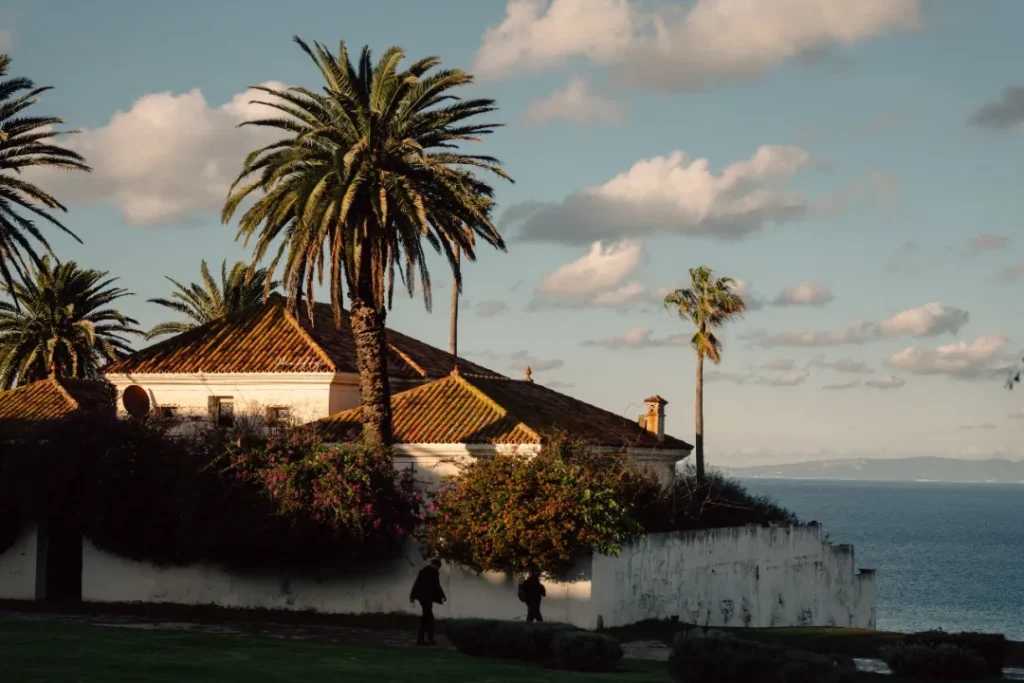
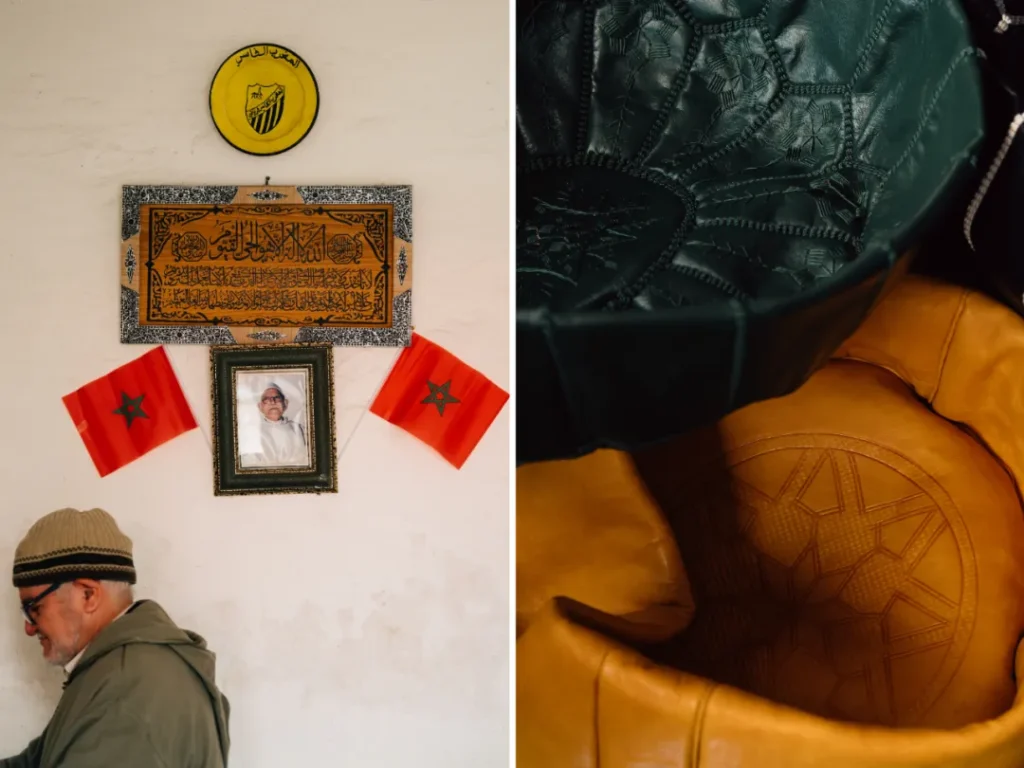
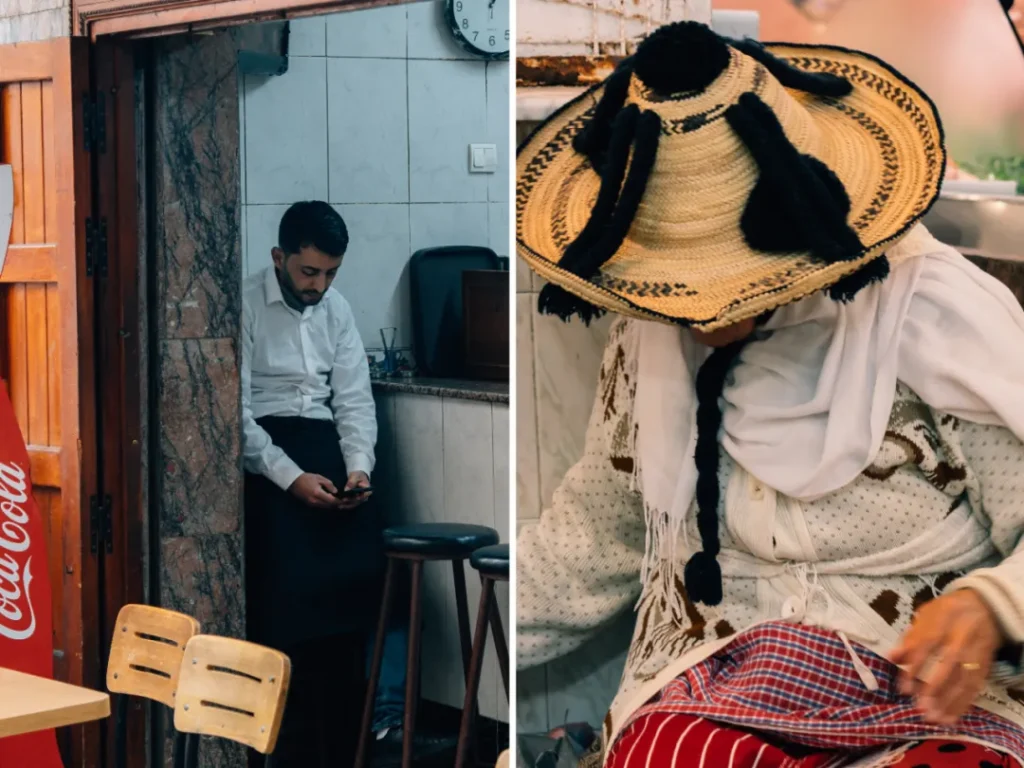
Kerouac and Ginsberg came together one spring, intending to help Burroughs bring some order to those scattered fragments. But Kerouac later remarked that Tangier was the only city that had ever made him feel that words were superfluous. The city itself was already a novel, intricately structured and already written; anyone who attempted to lay another narrative over it was simply gilding the lily.
There is a name that Tangier’s literary history too often neglects: Jane Bowles.
As Paul Bowles’s wife, she has long been submerged beneath her husband’s reputation, and yet she was the one who truly worked herself into the city’s flesh and blood. She learned the dialect, haggled in the markets, made friends with local women. Her Tangier was not the detached, faintly anthropological Tangier of her husband’s pages but something more immersive, more bodily. Her later years in the city were tragic: a stroke in 1957 left her to spend much of the remaining time in the dual torment of illness and the effort to write, until her death in a Spanish psychiatric hospital in 1973. Some say that the intensity of Tangier, its cultural shockwaves and its unrelenting tension, accelerated her collapse. For those who truly attempt to enter Tangier from within, the cost is steep. It is not a city that consents to be enjoyed lightly; it demands total commitment, and total commitment tends to mean leaving some part of yourself here permanently.
For a long time, Moroccan voices were little more than a silent backdrop in the narratives these Western writers produced. Then came Choukri. This writer, who had scavenged for bread in the streets as a child, set down in language raw almost to the point of savagery the story that became For Bread Alone: hunger, violence, the bare instinct to survive. The bitter irony is that this most native of works could only reach the wider world in the beginning through Paul Bowles’s English translation. The power asymmetry between the mediator and the subject lies exposed in Tangier’s literary history without any attempt at concealment. Yet it is precisely this entanglement, this misreading of power, this borrowing between cultures, this mutual dependence, that constitutes Tangier’s truest mixed nature.
Today the city is full of century-old teahouses and cafés that people from the cultural world come to pay their respects to. Almost every proprietor will mention proudly that Bowles used to stop in for coffee, that Matisse once sat by the window one afternoon and made a sketch.
No one verifies these claims. In Tangier, the line between documented history and transmitted legend dissolved long ago, and there is no longer any way to trace it.
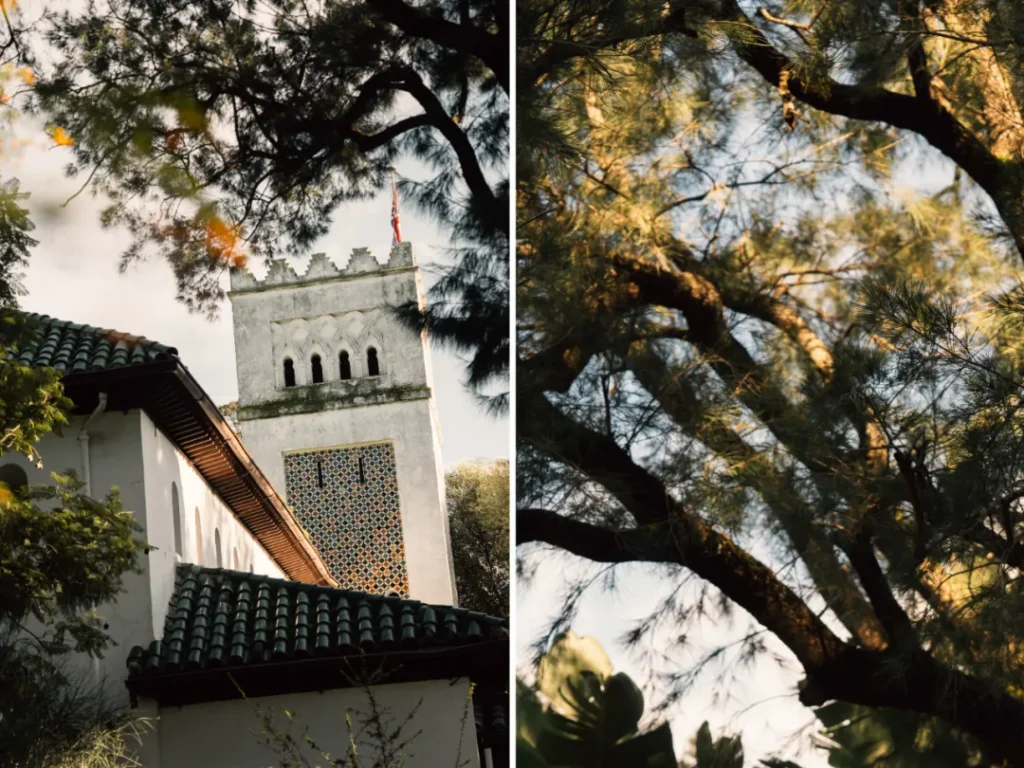
As dusk fell, I drank a third glass of sharply bitter mint tea in a teahouse on the Petit Socco. Through the window, the harbour cranes turned slowly in the fading light, and a ferry carrying its cargo of exile-dreams slipped out of port toward Gibraltar. I tried to picture the souls who had once sat in this same spot, and thought: what they were really writing was humanity’s oldest predicament. How to find one’s footing in a place that refuses to offer any stability. How to make a language of one’s own out of total estrangement.
Tangier offered them no answer. With the deep, knowing fatigue of something that has seen everything, it simply gave them more questions.
For a writer, that is perhaps the most generous gift a city can give.
One More Glass of Mint Tea
In the cafés and teahouses of Tangier, time undergoes a particular transformation.
These establishments serve a special function in the city. Four or five century-old teahouses can stand side by side along a single block, and nowhere else in Morocco can rival Tangier for the antiquity and depth of its café culture.
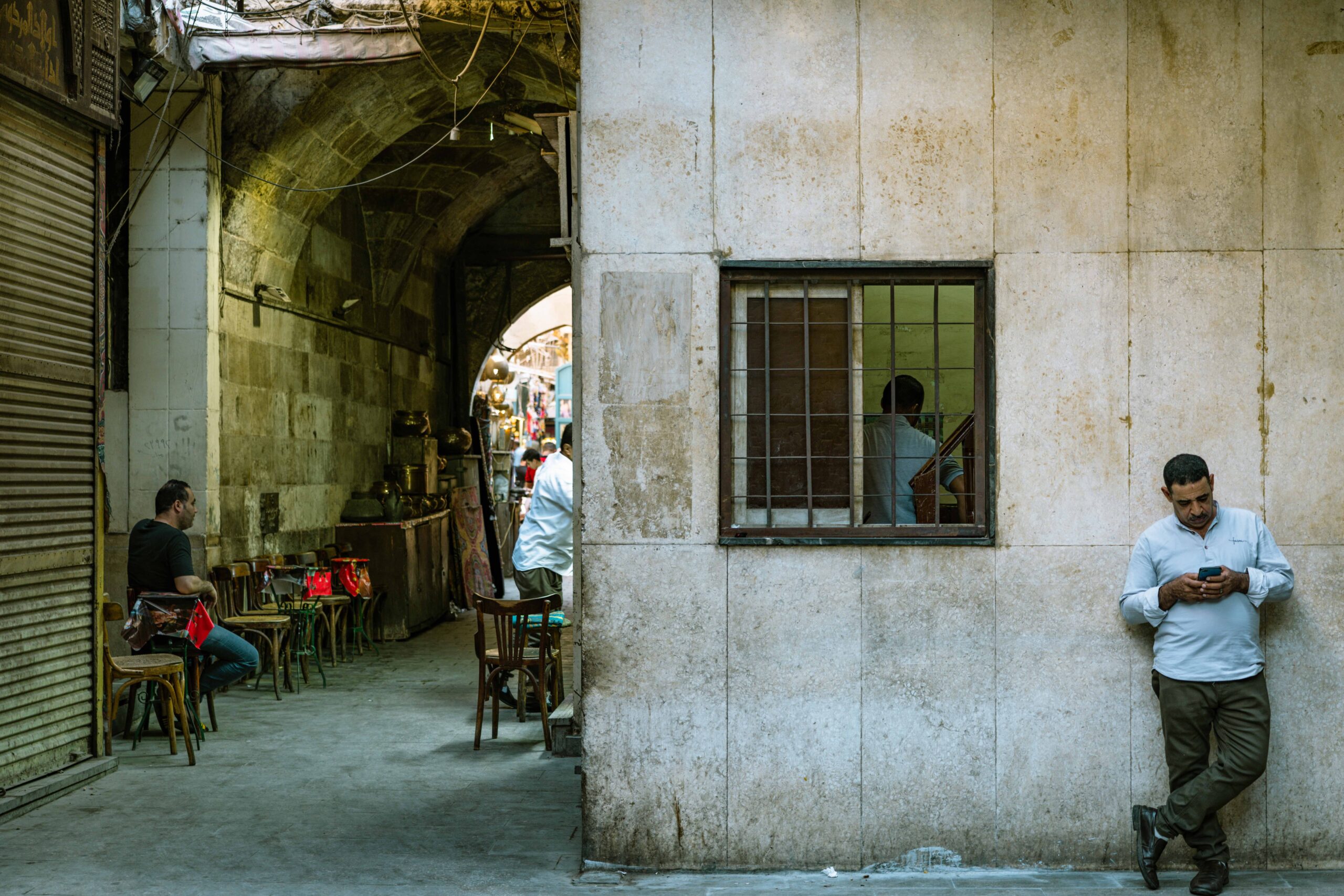
The rooms are small, kept in the style of the nineteen-fifties and sixties. Against one wall there is usually an old television broadcasting Arabic news or a football match at low volume, and no one looks up at it. All the chairs and stools face in the same direction: toward the street that leads to the Strait of Gibraltar. They are arranged in single or double rows like theatre seating, and the street itself is the performance that never closes.
The waiters wear trim dark-red or black uniform jackets, as though they had stepped directly out of the nineteen-fifties and kept walking. Their bearing is composed; they speak several languages; their manner carries a deliberate formality that has become difficult to find in most places today. These conventions were born in the era of the French and Spanish protectorates, when colonial administrators built cafés in Morocco modelled on the Parisian golden age: mirrored walls, zinc counters, rattan chairs, and a particular mode of service. Tangier, as an international zone rather than a French protectorate, received the layered influence of several European café cultures simultaneously, and the result is a hybrid that cannot be fully assigned to any single template. Those conventions of service, the uniforms, the posture, the precise arc of the arm as tea is set down, were designed for a specific clientele, intended to produce a sensation of civilisation distinct from local custom, the reassuring sense of order confirmed even in a foreign land.
Independence came, the colonists departed, and the conventions remained.
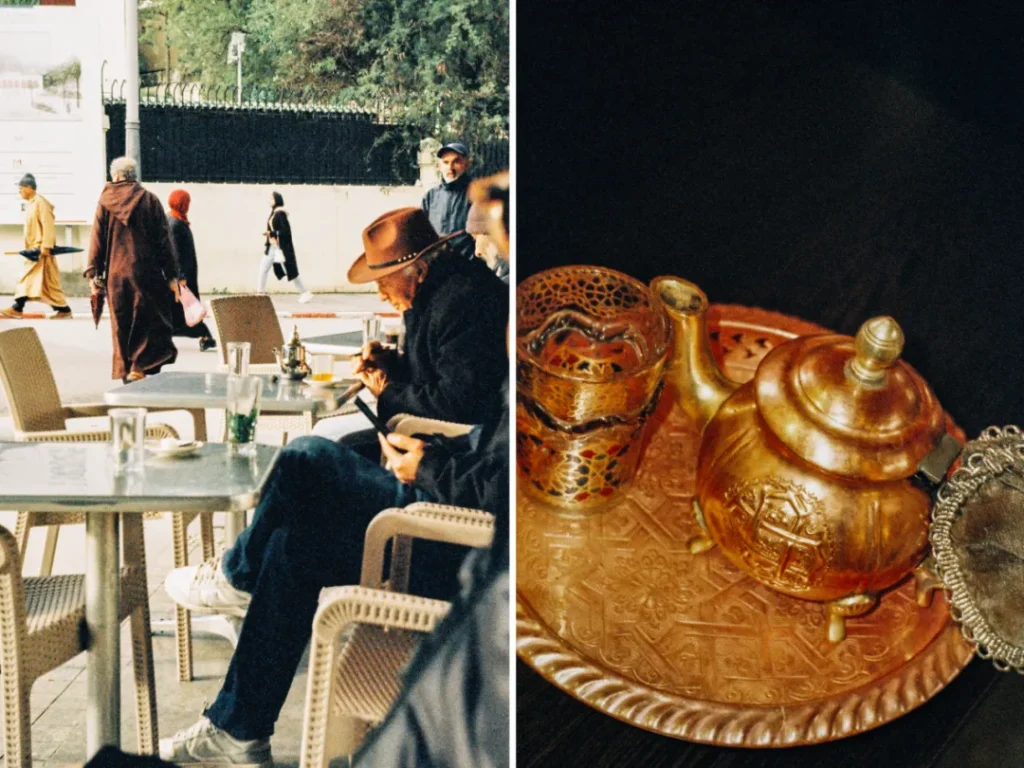
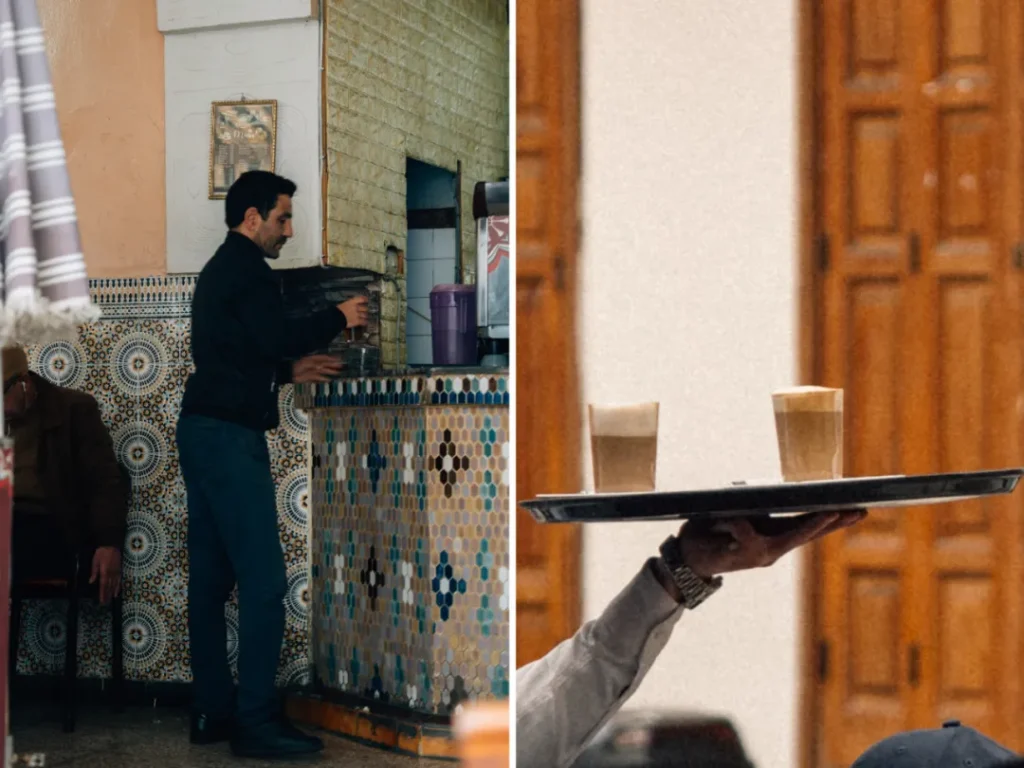
During my time in Tangier I visited several cafés, each with its own character. The most celebrated is the Café Hafa, on a clifftop in the Marshan district, founded in 1921 and now past its centenary, its terraces stepping down the cliff-face in tiers, each one facing the Strait, with the Spanish coastline visible on clear days. Bowles was a regular; for Tangierinos themselves, Hafa is a place they have been going since childhood. There is also the Café Baba in the Kasbah, tucked into a corner among the white buildings, its walls covered in old photographs of distinguished visitors across the years: Kofi Annan, the Swedish royal family, and several black-and-white frames of the Rolling Stones. But the places I returned to most often were the Café de Tingis and the Café Central beside the Petit Socco, century-old establishments that serve as staging posts in the daily current of Tangier life.
In all these cafés, the clientele is almost exclusively male.
Moroccan cafés have long occupied a middle ground between the public and the private. Between the old neighbourhood establishments dominated by men and the growing number of modern coffee shops, there runs an unspoken line of gender. The regulars of the old places are almost entirely men, and women who wish to enter a public tea-drinking space tend to self-select, gravitating toward venues with no strong association with any particular neighbourhood.
On my last evening, I returned to the Café Central on the Petit Socco. After dark, the city’s noise settles into something more intimate, the sound of a place that knows time will wear everything away, and has made a long peace with this knowledge.
Tangier has watched empires withdraw, the Beats scatter, travellers shoulder their bags, and countless residents slip away by night on the ferries, including those who could not have said what exactly they were fleeing. Departure is something this city has always been good at witnessing.
Yet the hills of Europe will still appear through the morning haze across the Strait; the city will still have its inexhaustible sun to idle in; year after year the cycle turns, like an endless play unfolding before the teahouse door, its scenes of departure and return, of loss and beginning again, long since memorised by everyone here.
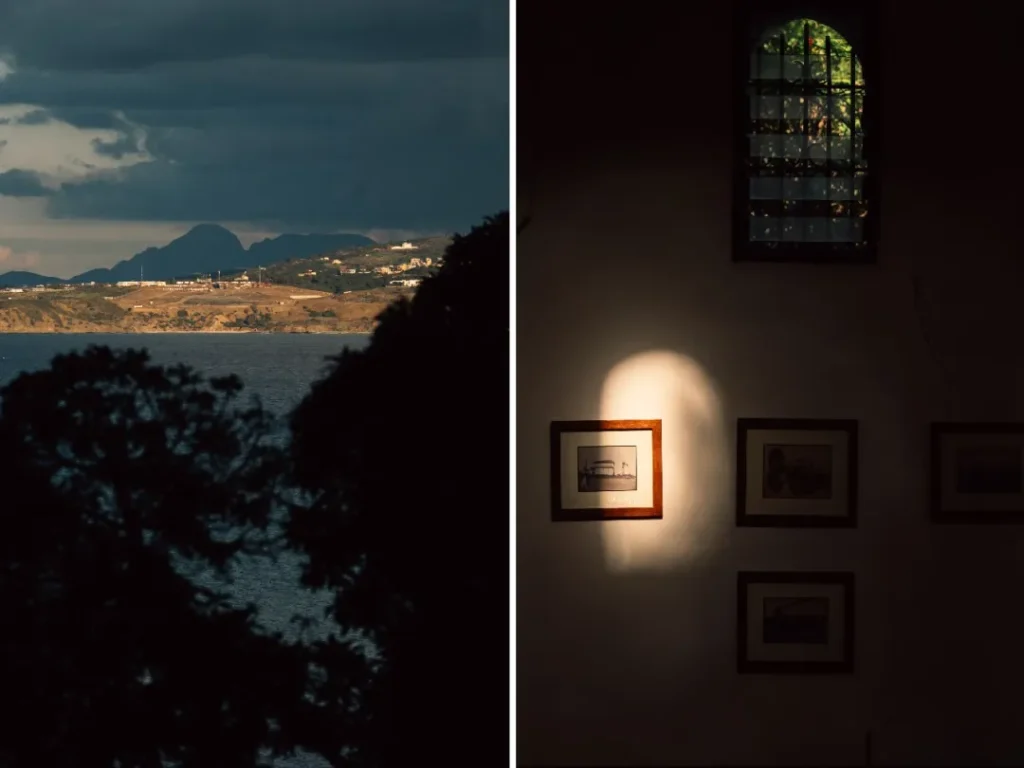
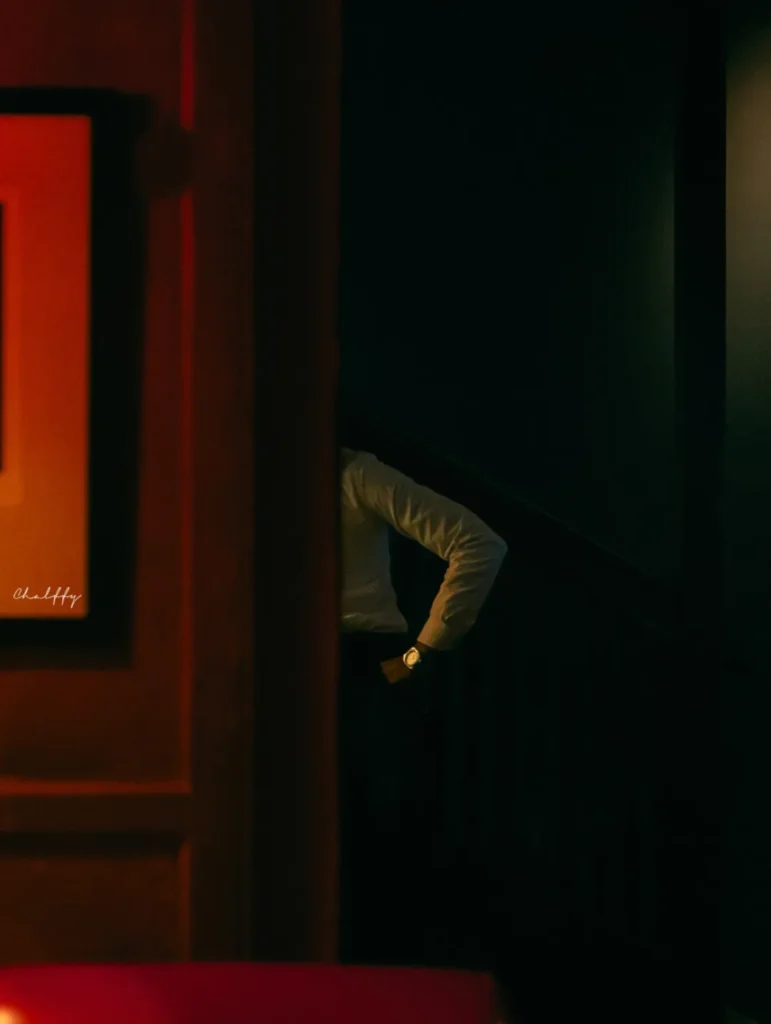
I find myself often thinking about the stories we tell ourselves and others: who we are, what we are doing, what part we play in the world, where our worth lies, what our lives finally mean. I sometimes wonder whether my susceptibility to such questions comes from the very way these Tangier novels are built, less like fiction than like a brief for the ideal self, the authors’ projections of who they wished to be, their private fantasies given form. How desperately they wanted to picture themselves as the bold and dissolute, the untameable artists and rebels and wanderers of their own stories, and so they wrote those epics in faithful service to their own desires.
Or perhaps, when all borders are loosened and all constraint falls away, what determines a person’s fate has never been freedom at all, but simply what they carried with them from the beginning.